
What do Hong Kong business consultants recommend for flexible office solutions?
Hong Kong rewards businesses that can move quickly, yet its office market often asks founders to make long commitments before their revenue, headcount, or local strategy is clear. What flexible office approach can suit Hong Kong businesses? A practical approach is to match the workspace to the stage of the business, using an address, desk, meeting room, or private suite only when the operation needs it.
Key Takeaways
- Hong Kong rewards businesses that can move quickly, yet its office market often asks founders to make long commitments before their revenue, headcount, or local strategy is clear.
- What flexible office approach can suit Hong Kong businesses?
- A practical approach is to match the workspace to the stage of the business, using an address, desk, meeting room, or private suite only when the operation needs it.
This approach protects cash flow while giving a company a credible base in the city. It also supports remote workers, non-local talent, and distributed teams that need somewhere professional to work without rebuilding their setup each time they arrive.
How Flexible Workspaces Lower Barriers to Entry in Hong Kong
The Weight of Traditional Commercial Leases
A conventional office lease can place several demands on a new company at once: a security deposit, advance rent, furniture, internet installation, insurance, business registration paperwork, and a commitment that may outlast the original business plan. In central commercial districts, rent is only one part of the calculation. A founder also pays for unused desks, reception coverage, cleaning, utilities, maintenance, and the time required to manage a physical site.
That fixed cost structure is difficult for a solo consultant, early-stage startup, or overseas team testing demand in Hong Kong. Market conditions can change before a long lease reaches its midpoint. A company may need a Mandarin-speaking meeting environment one month, a Cantonese-capable local contact the next, and a temporary project room after that. Traditional premises rarely adjust at the same speed.
On-Demand Booking as an Equalizer for New Founders
Flexible offices separate access from permanent occupancy. A founder can start with a professional business address, reserve a conference room for client meetings, and book a desk only on the days that require focused work. This reduces upfront exposure and keeps workspace spending closer to actual usage. Flexible commitments can suit startups that need to adapt their workspace arrangements as business needs change.
The savings can be meaningful. A virtual office and on-demand meeting rooms may reduce rent and utility costs compared with maintaining a full-time office. The right setup also gives a new founder a reliable routine: a known place to take calls, meet partners, store work materials, and operate with greater confidence.
Comparing Recommended Solutions: Virtual, Coworking, and Private Offices
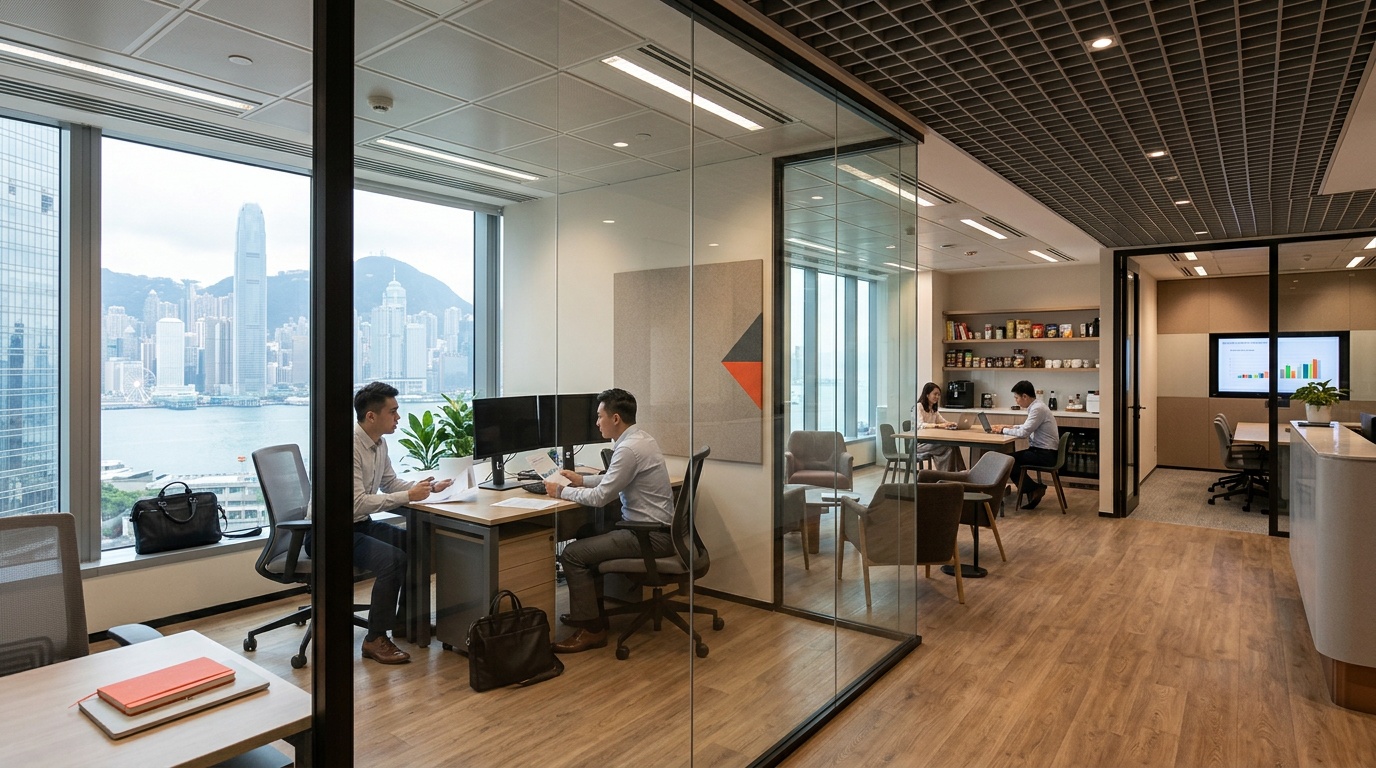
What flexible office approach can suit Hong Kong businesses? Begin with the work pattern, not the room itself. A virtual office suits a company that needs a local address and administrative presence. Coworking supports people who need mobility and occasional interaction. A managed private office fits teams that require privacy, control, and a consistent base.
Virtual Offices for Compliance and Corporate Legitimacy
Virtual-office services vary by provider and may include a business address, mail handling, call support, and access to meeting rooms when physical appointments arise. Confirm the available services before booking. A provider cannot replace professional legal or accounting advice, and registration requirements should be confirmed with the relevant Hong Kong authorities. For early operations, the model can keep administrative overhead low while giving clients, banks, and suppliers a stable business identity.
Coworking and Hot Desking for Mobility
Hot desking works well for solopreneurs, visiting executives, freelancers, and hybrid employees who need reliable Wi-Fi, power, ergonomic seating, phone booths, and a place for video calls. It also creates repeated proximity to other professionals, which can make local introductions more natural than working alone from an apartment. Flexible access can be part of normal work planning for finance and technology employees.
Managed Private Offices for Enterprise Teams
Managed suites are better suited to MNC project teams, regional departments, and companies handling sensitive conversations. Available services vary by provider; confirm dedicated rooms, access controls, reception services, IT support, meeting facilities, and team-layout options before booking. What flexible office approach can suit Hong Kong businesses? For an enterprise rollout, consider a setup that can expand by team, location, or project while preserving security and operational consistency. Confirm the available services at Am Office Space before booking.
| Workspace model | Best fit | Typical purpose | What to verify |
|---|---|---|---|
| Virtual office | Overseas founders and lean companies | Business address, mail handling, occasional meetings | Address eligibility, documentation, call handling, room access |
| Coworking or hot desk | Solopreneurs, freelancers, and mobile staff | Daily work, focused sessions, client calls, informal introductions | Internet reliability, phone booths, access hours, seating policy |
| Managed private office | MNCs and established project teams | Confidential work, team coordination, regional operations | Access control, IT support, meeting capacity, expansion terms |
Navigating Prime Districts and Regulatory Compliance
What flexible office approach can suit Hong Kong businesses? Begin with the address and the business activity it must support. A recognized location in Hong Kong can give clients, suppliers, investors, and banking contacts a clear point of reference, even when the team works across several cities. The address should not be selected for prestige alone. It should match meeting requirements, mail handling, company registration needs, transport access, and the level of local visibility a business expects.
The Strategic Value of Central, Admiralty, and Quarry Bay
Central places a company close to financial institutions, professional services, international retailers, and established corporate offices. Admiralty offers strong connections between government, legal, finance, and commercial districts. Quarry Bay is a practical choice for technology companies, media teams, and regional operations that value access to major employers and efficient transit. Each district sends a different signal, so founders should consider where clients already work and where in-person meetings are most likely to happen.
Businesses may seek virtual offices and business addresses in Hong Kong’s prime districts. That interest can reflect a practical need: businesses may want a credible base, mail reception, and meeting access without carrying the cost of unused desks and long lease obligations.
Meeting Hong Kong’s Regulatory Standards
A virtual office can support compliance by providing a formal business address and an organized channel for correspondence. It does not automatically satisfy every registration, licensing, tax, or sector-specific obligation. The provider’s documentation, permitted use of the premises, mail procedures, and access to meeting facilities should be reviewed before registration. Founders should also confirm requirements with a qualified accountant, company secretary, or legal adviser, especially if the business handles regulated financial activity or hires locally.
- Confirm that the address is suitable for the intended company registration and business activity.
- Ask how official mail, government notices, and time-sensitive documents are received and forwarded.
- Check whether the workspace can provide meeting rooms for client appointments, inspections, or banking discussions.
- Review privacy controls, access records, document handling, and authorized contact procedures.
- Verify whether the plan can add desks, phone support, or short-term office access as operations develop.
The strongest arrangement connects the registered address with real operating capacity. A founder may use the address for administration, then reserve a desk or meeting room during a Hong Kong visit. Am Office Space is a workspace listing; confirm its available services before booking.
Physical Presence as a Tool for Market Penetration
Hong Kong is compact, connected, and highly competitive. That density can help a new company reach decision-makers, yet it can also make remote work feel disconnected. A person working from an apartment may have excellent internet access and still lack regular contact with local operators, referral partners, language support, and industry-specific knowledge. A flexible workspace adds structure to that gap. Repeated presence in one location makes introductions more natural, while meeting rooms give a young company a professional setting for sales conversations and onboarding.
Overcoming the Lack of Structured Networking
Networking does not need to be a scheduled performance. It often begins with smaller signals: seeing the same people at a shared table, learning which neighborhoods suit certain industries, receiving a practical recommendation, or being introduced after a conversation about a client problem. Coworking can support these moments through proximity and routine, but the value depends on how often a person is present. A one-day visit may provide a desk. Regular bookings create recognition.
This matters for solopreneurs and non-local talent facing language barriers or an unfamiliar hiring market. A workspace with clear reception procedures, comfortable meeting areas, reliable video conferencing, and access to professionals from different sectors can reduce the isolation of working alone. It can also help a founder prepare for conversations in English, Mandarin, or Cantonese without making local connection a marketing promise.
Bridging the Gap Between Local Presence and Global Operations
Flexible offices are also useful for companies that operate across time zones. A regional manager may need a quiet room for a call with Singapore, a sales team may require a client-facing address in Hong Kong, and a visiting executive may need a desk for two days. One workspace account can support these different patterns without forcing every employee into the same schedule. Booking records, room availability, access instructions, and dependable connectivity matter as much as the physical design.
Case example: A virtual office combined with on-demand meeting rooms may reduce rent and utility costs. The lesson is not that every company will achieve the same saving. It is that a local presence can be separated into distinct needs: an address for formal correspondence, a room for important meetings, and temporary workspace for focused delivery. That separation preserves cash while keeping the company visible and ready to meet clients.
For a distributed team, Am Office Space is a workspace listing whose available services should be confirmed before booking. The principle is straightforward: maintain a dependable professional setting, book it around actual work, and let the operating footprint expand only when customer demand and team requirements justify it. What flexible office approach can suit Hong Kong businesses? Consider infrastructure that supports repeated local presence without making movement feel like another full business reset.
A Practical Framework for Evaluating Your Workspace Needs
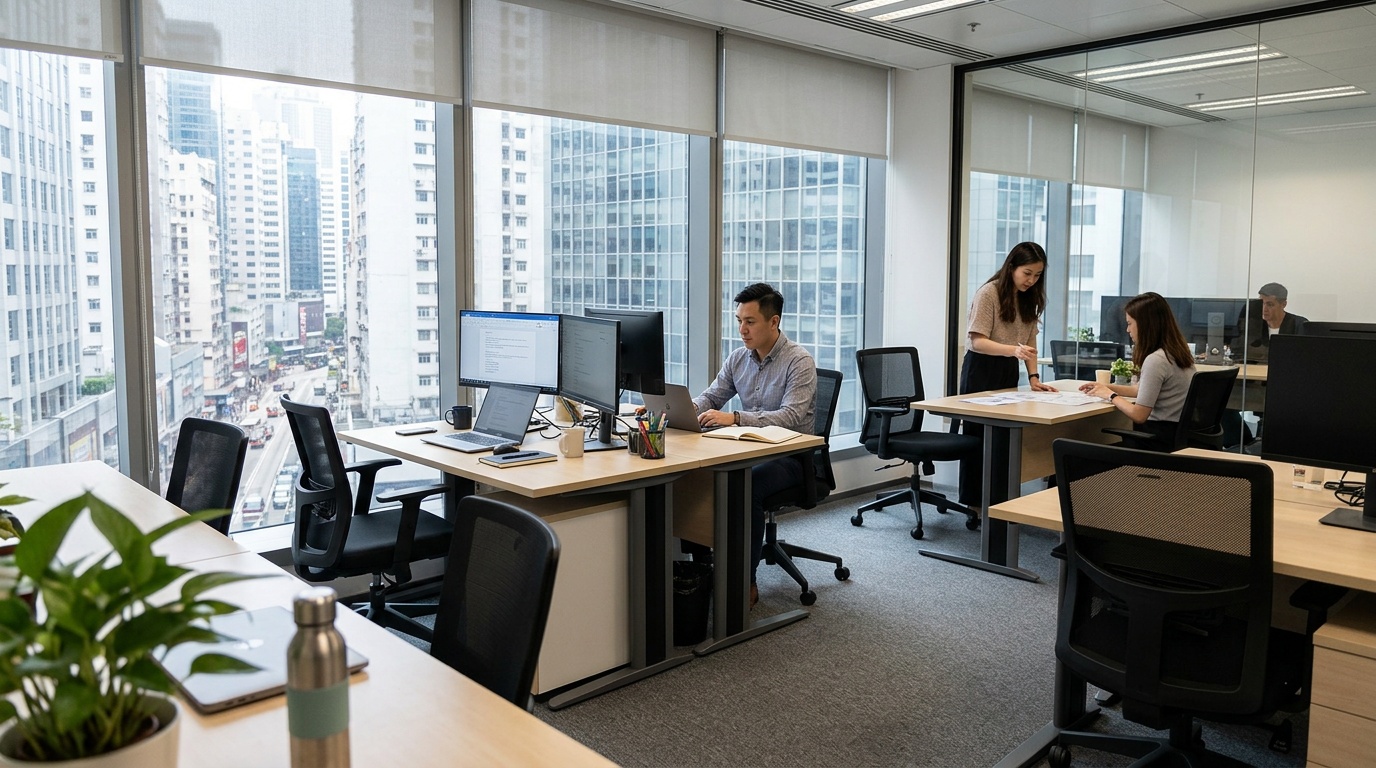
What flexible office approach can suit Hong Kong businesses? Start with the operating model, then select the smallest workspace that supports revenue, compliance, collaboration, and client trust. A useful decision should account for monthly cash flow, expected travel, team size, meeting frequency, data security, and growth plans. The goal is not to secure the largest office available. It is to create a dependable work base without paying for capacity that remains unused.
Budget Allocation and Return on Investment
Build the budget around actual work patterns rather than a fixed image of what an office should be. List recurring needs such as a business address, desk access, meeting rooms, call handling, printing, storage, internet, and reception support. Then separate those costs from occasional requirements, including workshops, interviews, client presentations, and visiting staff. This makes it easier to choose a monthly membership with additional bookings instead of a large package that includes services the team rarely uses.
Calculate the full cost of traditional premises before making a comparison. Include deposits, furniture, utilities, cleaning, insurance, technology installation, maintenance, commuting time, and the cost of empty desks. A virtual office with on-demand meeting rooms may reduce rent and utility costs. This is not a guaranteed result, yet it shows why cash preservation deserves a place in workspace planning.
Use a simple monthly review: compare workspace spending with client meetings hosted, productive workdays delivered, travel avoided, and administrative time saved. If a plan does not support those outcomes, adjust the access level before adding more space. A short commitment also gives a startup room to respond to hiring changes, seasonal demand, and market volatility.
Checklist of Essential Amenities and Infrastructure
A polished interior is useful only when the infrastructure supports focused work and professional communication. Before booking, request clear details about access hours, internet performance, privacy, room availability, and support procedures. Remote workers and solopreneurs should pay special attention to phone booths, ergonomic seating, quiet zones, natural light, power outlets, and reliable video call conditions. A good workspace should make an ordinary workday easier, not introduce new points of friction.
- Confirm business address eligibility, mail receipt, document handling, and notification procedures.
- Check Wi-Fi reliability, backup connectivity, power access, and technical assistance.
- Review conference room pricing, booking windows, cancellation terms, and room capacity.
- Look for private call areas, sound control, secure entry, and visitor management.
- Ask whether reception staff can support English, Mandarin, or Cantonese communication.
- Verify printing, scanning, lockers, kitchen access, accessibility, and cleaning arrangements.
- Review data protection practices before discussing financial, legal, or customer information onsite.
For a practical reference, Am Office Space is a workspace listing; confirm its available services before booking. The same evaluation principle applies in Hong Kong: confirm the facilities that matter to the business, then pay for access that matches use. Am Office Space should be evaluated based on its listed services and the business’s actual requirements.
Matching Space to Team Size and Work Habits
Team size is only one part of the decision. A five-person company that travels often may need fewer dedicated seats than a three-person team handling confidential client work every day. Map the week by activity: individual focus, video calls, in-person meetings, collaboration, storage, and quiet work. A solo consultant may need a hot desk and occasional conference room. A growing startup may need several assigned seats with the ability to add capacity each month. An MNC project team may require a private suite, controlled access, and dependable IT support.
- Record demand: Track how many people need workspace, on which days, and for how many hours.
- Group the tasks: Separate confidential work, client meetings, team sessions, calls, and administrative duties.
- Choose the base: Select virtual access, shared seating, dedicated desks, or a private office according to the dominant task.
- Test the arrangement: Use a short booking period and gather feedback on noise, commute, connectivity, privacy, and room supply.
- Set review points: Reassess after a defined operating period, especially after hiring, entering a new market, or changing travel patterns.
The clearest recommendation is to keep the workspace proportional to the business stage. Start with the minimum credible setup, measure how people actually work, and add services when demand is visible. What flexible office approach can suit Hong Kong businesses? A flexible arrangement that protects cash, supports local credibility, and can change without forcing the company through another expensive reset.
Mohamed Khaled
Founder & CEO at Hotdesk & Co-founder, DESK Token
Mohamed Khaled is the Founder and CEO of Hotdesk, an on-demand workspace platform.
He previously worked at PwC before moving into financial leadership at SWVL.
Mohamed built Hotdesk from a side project into a workspace platform.
Also being Co-founder and President of DESK Token, Mohammed is focused on building infrastructure for underutilized assets, from meeting rooms to private offices and full on buildings, while creating space for the future of work.
Leave a Reply