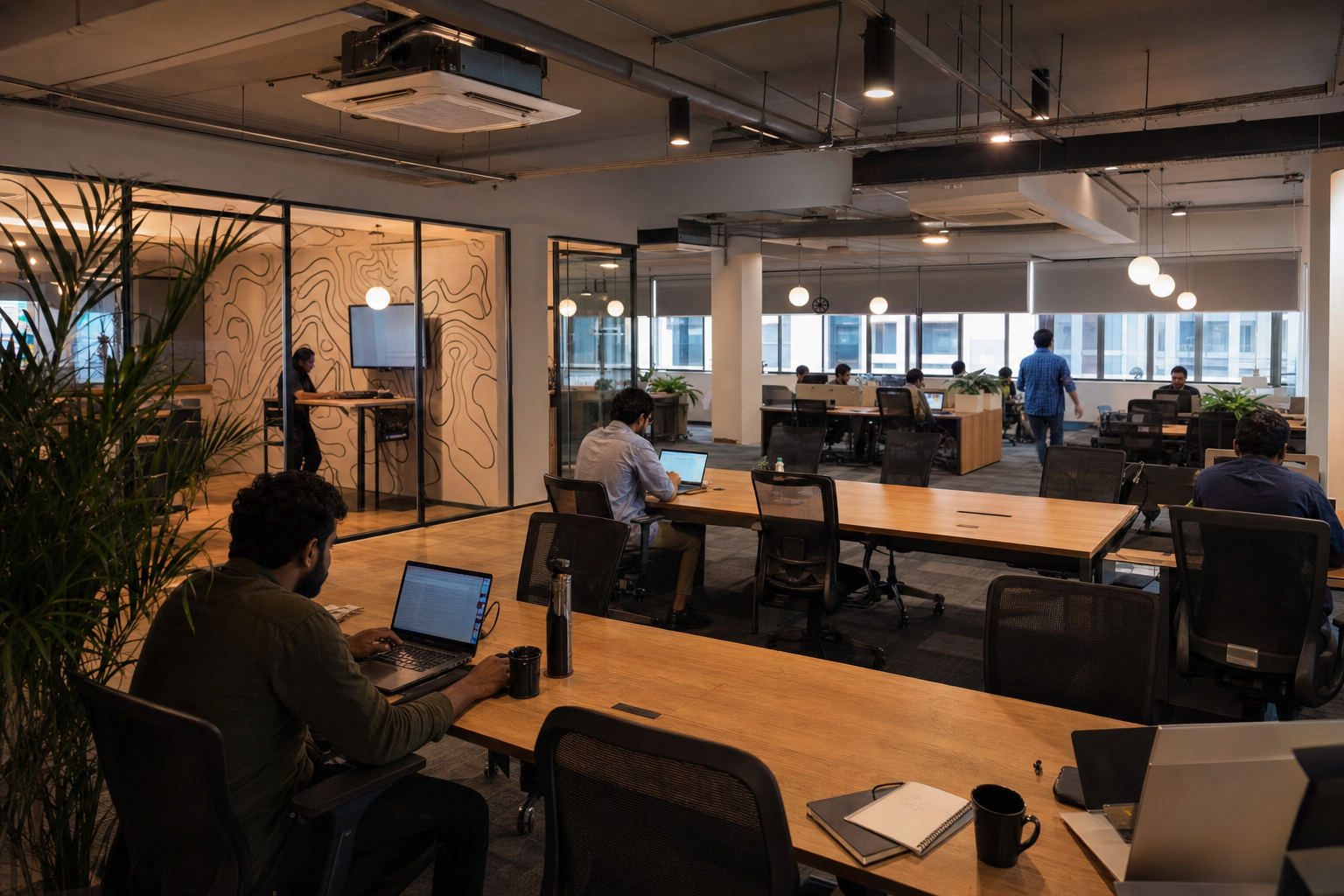
Are industry reviews recommending specific coworking spaces in Kochi for productivity?
Infrastructure travels with the user, meaning reliable environments must function consistently across different districts. Spaces that prioritize power redundancy, cooling capacity, and acoustic damping protect output quality. This approach shifts the evaluation from marketing descriptions to operational reality.
How Industry Reviews Rate Kochi Coworking Spaces for Focus
What reviewers prioritize in Kochi
Reviewers evaluate power redundancy first. Spaces equipped with automatic transfer switches and diesel generators prevent workflow interruption during grid outages. Cooling capacity determines comfort in high-humidity zones, directly impacting cognitive load during extended work sessions. Reviewers also assess acoustic damping to reduce distractions and maintain deep work states.
Infrastructure travels with the user, meaning reliable environments must function consistently regardless of regional weather patterns. Spaces like Coworking Naubostik demonstrate how standardized protocols protect output quality, even when local conditions vary. This emphasis on system reliability over superficial features allows professionals to trust their workspace investment.
Top-rated spaces by district and metro access
Aggregators consistently highlight Business Bureau Panampilly, Innerspace, Workbench, Soul of Work, Centre A, and Collective Coworking. These operators cluster in Panampilly Nagar and the Kakkanad corridor, positioning themselves near Infopark and SmartCity to minimize commute friction. Proximity to transit hubs improves time optimization for professionals working in tech corridors.
| Space Name | District | Key Infrastructure Metric |
|---|---|---|
| Business Bureau Panampilly | Panampilly Nagar | Fiber Uptime Reliability |
| Innerspace | Kakkanad | Cooling Capacity & HVAC |
| Workbench | Edappally | Acoustic Isolation Design |
| Soul of Work | Kakkanad | Power Backup Systems |
| Centre A | Fort Kochi | Network Latency Stability |
| Collective Coworking | MG Road | Energy Efficiency Ratings |
Pricing tiers and actual productivity value
Day pass prices range from ₹249 to ₹600 across various operators. Budget-conscious users often compare these rates against cafe costs, yet cafe environments introduce unpredictable noise, device overheating risks, and lack of power redundancy. The productivity value justifies the premium when factoring in uninterrupted bandwidth and ergonomic support.
Reviewers calculate value by measuring effective working hours against expenditure. High-throughput Wi-Fi and reliable climate control enable longer focused sessions without environmental degradation. This metric reveals that professional spaces deliver higher return on investment through sustained output rather than lower upfront costs.
Baseline amenities versus infrastructure reality
Marketing claims often obscure infrastructure reality. Reviewers distinguish between decorative amenities and functional systems that directly impact performance. Baseline expectations include 24/7 access control, high-throughput network architecture, and rigorous pest management protocols. Spaces that invest in perimeter sealing and advanced air handling units maintain higher satisfaction scores than those relying on open layouts.
Are industry reviews recommending specific coworking spaces in Kochi for productivity? The consensus favors operators who document service level agreements and invest in environmental monitoring. Spaces with IoT sensors for temperature and humidity regulation receive higher praise for maintaining optimal working conditions. This data-driven approach separates functional workspaces from those offering superficial comfort.
User Sentiment Versus Professional Recommendations
What remote workers report on Reddit and Quora
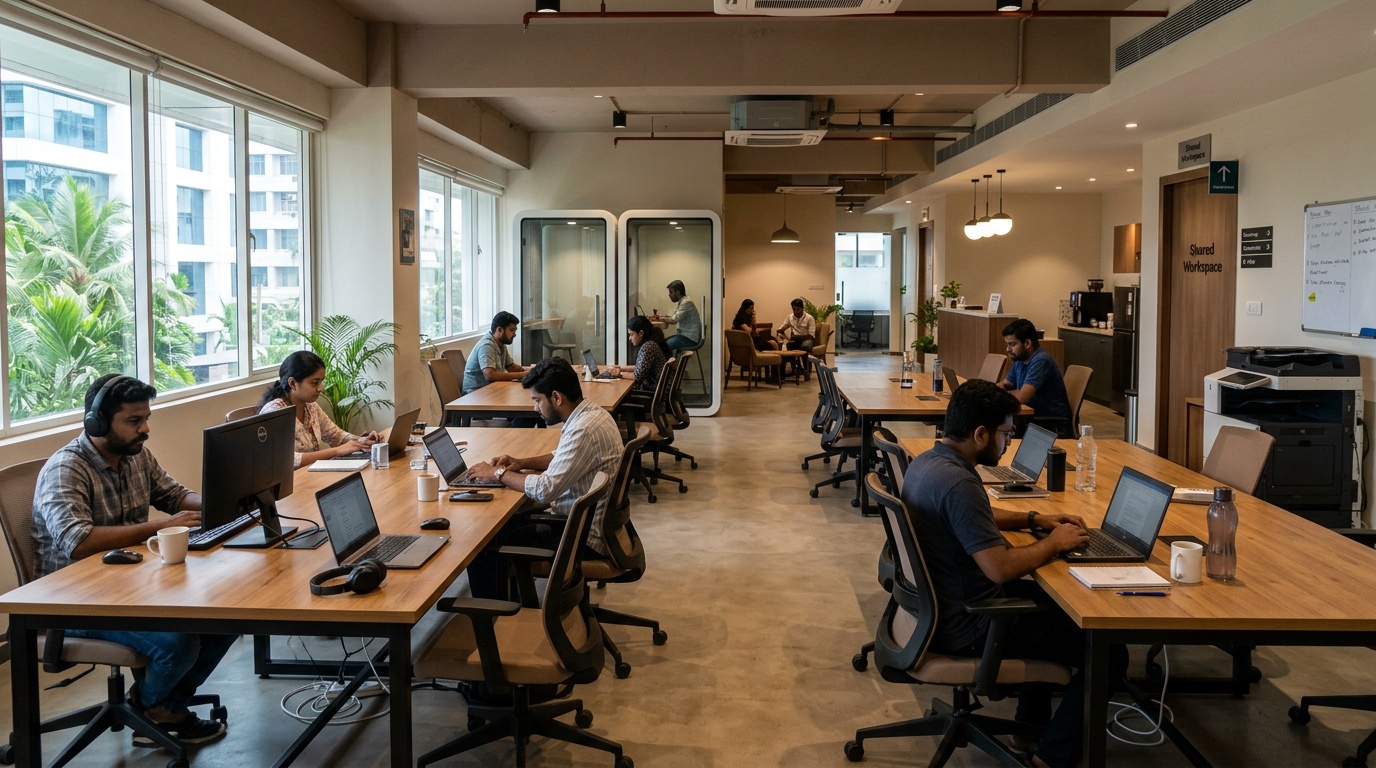
Remote workers discuss operational challenges on platforms like r/Kochi, highlighting real-world friction points. Users report humidity damage to electronics and mosquito exposure in semi-open areas, issues that curated lists often overlook. Community feedback reveals gaps between listed amenities and actual daily conditions, particularly regarding pest control and ventilation.
Are industry reviews recommending specific coworking spaces in Kochi for productivity? User sentiment validates professional recommendations when infrastructure holds up under stress. Reviewers who prioritize acoustic isolation and thermal insulation consistently receive positive feedback from community members dealing with noise complaints and climate issues.
Where expert lists align with ground truth
Curated lists from sources like Indiastudychannel and CoFynd align with ground truth when focusing on established operators. Expert recommendations tend to favor spaces with documented track records and transparent operational standards. User sentiment confirms these choices when members experience consistent service delivery and responsive community management.
Are industry reviews recommending specific coworking spaces in Kochi for productivity? The alignment strengthens when expert criteria include power backup verification and network uptime guarantees. Spaces that meet these rigorous standards emerge as reliable options for professionals requiring uninterrupted access to cloud resources and communication tools.
Managing noise and climate complaints
Noise complaints correlate with poor acoustic isolation and lack of designated quiet zones. Climate issues stem from inadequate ventilation and insufficient cooling capacity in high-occupancy areas. Spaces that deploy strategic layout planning with acoustic pods and sound-dampening materials receive higher satisfaction ratings.
Are industry reviews recommending specific coworking spaces in Kochi for productivity? Reviewers emphasize the importance of environmental controls that maintain consistent temperature and air quality. Operators investing in green building standards and energy-efficient systems demonstrate commitment to member comfort and sustainability goals.
The hidden productivity tax of long commutes
Commute distance impacts daily output significantly. Locations in Cherai or Mulavukadu introduce fatigue that reduces effective working hours and increases stress levels. High-density clusters like Kakkanad offer better time optimization for professionals working in tech corridors, preserving energy for focused tasks.
Pros of Proximate Coworking Spaces
- Reduced commute time preserves mental energy for deep work
- Easy access to transit hubs improves scheduling flexibility
- Lower transportation costs contribute to better overall value
Cons of Peripheral Locations
- Extended travel increases fatigue and reduces available working hours
- Higher transportation expenses erode cost efficiency
- Unpredictable traffic conditions create scheduling uncertainty
Are industry reviews recommending specific coworking spaces in Kochi for productivity? The data consistently points to locations near employment hubs as superior choices for maximizing daily output. Professionals prioritize convenience and reliability to maintain consistent performance across distributed work arrangements.
A Practical Framework for Scoring Workspace Productivity
Industry reviews often lean on subjective ratings that tell you little about actual output. When asking are industry reviews recommending specific coworking spaces in Kochi for productivity? the answer depends on whether those reviews measure what matters. Without quantifiable criteria, a five-star rating for decor does not help you choose between two spaces with identical aesthetics but different infrastructure reliability.
Key Takeaways
- Industry reviews that lack quantifiable metrics for infrastructure reliability cannot reliably guide productivity-focused choices.
- When evaluating coworking spaces, prioritize objective data on network uptime and power stability over subjective decor ratings.
- A space’s true productivity value emerges from consistent operational continuity, not from star ratings based on aesthetics.
- Without standardized criteria for measuring output, reviews risk recommending spaces that look good but fail to support sustained work.
- Decision-makers should seek reviews that include hard data on internet speed, backup power, and workspace availability rather than subjective impressions.
This framework replaces vague superlatives with verifiable metrics. Apply it when evaluating any workspace to ensure your decision rests on engineering reality rather than marketing claims. The goal is to isolate the variables that directly control your daily output and test them systematically.
Defining Measurable Productivity Metrics
Productivity in a coworking context reduces to three variables: uninterrupted focus time, network availability, and environmental consistency. Each can be measured. Focus time requires noise isolation that meets decibel standards for deep work. Network availability demands documented uptime guarantees, not aspirational language. Environmental consistency covers temperature, humidity, and air quality that stay within defined ranges throughout the workday.
Start by weighting these factors against your workflow. A software developer needs reliable internet above all else. A writer requires quiet and climate control. A team running client calls needs soundproof meeting rooms with consistent AC. Define your priorities before comparing spaces, and let each criterion carry a weight proportional to its impact on your output.
Evaluating Internet Reliability and Power Redundancy
Internet reliability is the single largest determinant of coworking productivity. Ask every space for its guaranteed bandwidth per user, not just total connection speed. A 100 Mbps line shared across fifty people delivers roughly 2 Mbps per person during peak hours. Request the provider name and confirm whether the connection is dedicated fiber or shared residential-grade cable.
Power redundancy matters equally. Kochi experiences voltage fluctuations during monsoon months. A workspace with dual UPS systems and generator backup maintains uptime when the grid falters. Coworking Naubostik exemplifies this standard by publishing its infrastructure specifications up front, allowing members to verify reliability before committing to a membership. Without these guarantees, a single three-hour outage erases an entire workday.
Climate Control and Pest Management Standards
Kochi tropical climate introduces productivity risks that reviews often ignore. Humidity above 70 percent damages laptops and causes physical discomfort that reduces concentration. Ask about AC temperature range and maintenance frequency. Spaces that maintain 22 to 24 degrees Celsius throughout the day demonstrate operational discipline. Those that rely on fans or partial cooling introduce productivity variance based on seat location.
Pest management is equally critical. Mosquito exposure in open or semi-open spaces disrupts focus and poses health risks. Reviewers on Reddit and Quora consistently flag this issue. Confirm whether the space uses professional pest control on a weekly schedule and whether windows and doors have screening. These operational details separate spaces built for productivity from those optimized for photography.
Matching Space Type to Workflow Density
Not all workflows benefit from the same layout. High-density workflows involving code writing, data analysis, or design require isolation. Low-density workflows involving research, reading, or planning can tolerate ambient noise. Match your flow to the space type. Private offices suit uninterrupted deep work. Dedicated desks in quiet zones work for daily routines. Meeting rooms with booking systems serve client-facing teams.
The following scoring matrix converts these criteria into a repeatable evaluation method. Apply it to every space you tour, and weight each row according to your specific productivity requirements.
| Criteria | What to Measure | Target Standard | Scoring Method |
|---|---|---|---|
| Internet bandwidth per user | Mbps per person during peak hours | 10+ Mbps per user | Test with Speedtest at 11 AM and 3 PM |
| Power backup coverage | UPS type, generator capacity, switchover time | Dual UPS plus generator, under 5 second switchover | Ask for maintenance logs and test results |
| Noise isolation | Decibel level at desk during peak hours | Below 50 dB for quiet zones | Use phone app to measure dB at three locations |
| Temperature consistency | Degree Celsius range across workstations | 22 to 24 degrees C maintained year round | Visit on a hot afternoon and check variance |
| Pest control schedule | Frequency of professional treatment | Weekly treatment with documented logs | Request treatment schedule and inspect for screens |
| Commute time from residence | Minutes door to door during peak traffic | Under 30 minutes for daily use | Test commute at 9 AM on a weekday |
Apply this framework to every space you evaluate. When industry reviews accompany these metrics rather than replacing them, they become genuinely useful. Coworking Naubostik represents one example of a space that publishes measurable infrastructure standards, allowing you to compare based on operational reality. For teams asking whether are industry reviews recommending specific coworking spaces in Kochi for productivity? this framework provides the answer through data, not opinion.
Booking Flexible Access Without Lock-In Contracts
The search for the ideal workspace often leads to a critical decision point: how to access it. Traditional leases and long-term commitments introduce friction, forcing users to predict future needs with often inaccurate foresight. This is where flexible access models redefine workspace strategy, turning a potential cost center into a productivity accelerator. When considering where to work, especially in a dynamic city like Kochi, understanding the booking mechanics is as important as the amenities offered. The question of are industry reviews recommending specific coworking spaces in Kochi for productivity? shifts when you realize that flexible booking itself is a productivity multiplier.
Infrastructure should travel with you, not the other way around. This principle applies directly to how you secure your workspace. Instead of signing lengthy contracts that tether you to a single location or commitment level, modern solutions offer on-demand access. This approach minimizes the risk of over-committing space you don’t need or being unable to scale up when opportunities arise. It’s about engineering your workspace solution for the actual demands of your workflow, ensuring continuity and reducing the need for costly re-configuration or resets.
Day Passes Versus Monthly Commitments
The spectrum of workspace access ranges from single-day passes to multi-month commitments. Day passes offer unparalleled flexibility, allowing professionals to pay only for the days they need office access. In Kochi, these passes typically range from ₹249 to ₹600, according to coworking aggregators like Coworkingers.com and Travell.cc. This model is ideal for freelancers visiting the city, remote workers needing a change of scenery for a specific project, or teams requiring ad-hoc meeting spaces. It eliminates the overhead of fixed monthly costs and the administrative burden of managing unused space.
Monthly memberships, while offering a predictable cost and a sense of belonging, can become a productivity tax if usage fluctuates. If your team’s presence in the office varies week to week, a fixed monthly cost for dedicated desks or private offices becomes inefficient. The engineering discipline behind a workspace solution is evident in its ability to cater to variable demand. A system that allows you to scale your access up or down based on project cycles or team attendance ensures that your workspace expenditure directly correlates with your operational needs, rather than a static, predetermined commitment.
Securing Meeting Rooms and Private Offices on Demand
Beyond the daily workspace, the need for private meeting rooms or dedicated office suites arises frequently. These spaces are critical for client presentations, team strategy sessions, or focused collaborative work. The traditional method involves booking well in advance, often with steep cancellation penalties or minimum usage requirements. This lack of agility can stifle project momentum and create unnecessary planning overhead.
Modern coworking platforms address this by enabling on-demand booking for meeting rooms and private offices. Imagine needing a soundproof room for an important client call in Mumbai, and being able to book and confirm it within minutes through a single interface. This capability is what we mean by systems that travel with the user. It ensures that booked space is always functional and available precisely when needed, without the complexity of negotiating individual contracts for each meeting room reservation. This precise execution means your team can secure project-specific environments without disrupting their primary workflow or incurring hidden costs.
Accessing Global Inventory Through a Single Platform
For businesses operating across multiple cities or countries, managing workspace solutions can be a logistical challenge. Each location might have different providers, booking systems, and contract terms. This fragmentation leads to re-work and inefficiency. The ideal solution offers a unified platform that aggregates coworking spaces worldwide, simplifying discovery, booking, and payment. This is where infrastructure engineered for scale becomes paramount.
Platforms like Hotdesk provide access to a global inventory of workspaces, from individual desks to private offices and meeting rooms, all bookable through one account. This means a team member in Kochi can find and book a desk, while another in Barcelona can access Coworking Naubostik for a day, all managed under a single, streamlined system. This capability ensures continuity of operations, regardless of geographical distribution. It allows businesses to standardize their workspace procurement process, focusing on productivity outcomes rather than administrative hurdles. When asking are industry reviews recommending specific coworking spaces in Kochi for productivity?, the ability to access a network of verified spaces globally adds another layer of productivity assurance.
Expert Tip
When evaluating flexible workspace options, prioritize platforms that offer transparent pricing and real-time availability. Look for spaces that detail their network infrastructure, such as dedicated fiber lines and backup power, as these are indicators of reliable uptime. Services that allow you to book by the hour or day, without long-term commitments, provide the greatest agility for dynamic workforces. This approach ensures your workspace adapts to your business, not the other way around.
Frequently Asked Questions About Access and Pricing
Understanding the nuances of flexible workspace access is key to maximizing productivity. Many professionals grapple with common questions regarding how these models function practically and what factors influence cost. For instance, the distinction between a ‘day pass’ and a ‘hot desk’ membership can be confusing. A day pass typically grants access for a single calendar day to open, unassigned seating, while a hot desk membership usually allows unlimited access to these unassigned seats for a fixed monthly fee. Both are designed for flexibility, but appeal to different usage patterns.
Another frequent query revolves around securing private spaces. While day passes cover open areas, booking meeting rooms or private offices often requires a separate reservation, sometimes with hourly or half-day rates. The pricing for these can vary significantly based on size, amenities (like AV equipment), and location within Kochi. When industry reviews discuss productivity, they often overlook the hidden costs of inadequate booking systems. A platform that consolidates all booking types. From day passes for individual work to meeting rooms for team collaboration. Under one billing umbrella simplifies financial management and ensures that seeking a productive environment doesn’t introduce administrative complexity.
For teams considering their options, understanding what works at 10x means looking beyond just the advertised price. It involves assessing the total cost of ownership, which includes the time spent managing bookings, potential downtime due to unreliable infrastructure, and the productivity lost when the workspace doesn’t match the task. Spaces like Coworking Naubostik, and indeed many others available through integrated platforms, are engineered to provide predictable performance and transparent pricing structures. By offering a clear breakdown of access types and associated costs, these solutions empower users to make informed decisions that directly support their productivity goals, ensuring that are industry reviews recommending specific coworking spaces in Kochi for productivity? becomes a question answered by operational efficiency rather than marketing hype.
Frequently Asked Questions
What are the disadvantages of co working space?
Coworking spaces can have disadvantages including noise distractions, power instability, and pest issues if infrastructure is not properly engineered. In Kochi, humidity spikes can damage electronics, and some spaces lack acoustic damping or pest management protocols. Reviewers note that open floor plans in semi-open areas often expose users to mosquitoes and overheating devices, reducing productivity.
Is Kochi an IT hub?
Yes, Kochi is a growing IT hub with major tech corridors like Infopark and SmartCity in Kakkanad. Industry reviews highlight that coworking spaces clustered near these employment hubs minimize commute friction for professionals. The district’s infrastructure investments and transit access support its rise as a reliable location for remote work and tech operations.
What is the future of coworking spaces?
The future of coworking spaces depends on engineering for scale with measurable infrastructure rather than superficial amenities. Operators who invest in power redundancy, cooling capacity, and acoustic damping will sustain output quality as external variables like grid failures and humidity persist. Spaces with IoT sensors and documented SLAs will gain preference over those relying on marketing claims.
Is coworking space a tax write-off?
Yes, coworking space expenses can be a tax write-off for self-employed individuals and businesses as a deductible business expense. The IRS allows deductions for rent, utilities, and internet costs when the space is used regularly and exclusively for work. Professionals should consult a tax advisor to apply the home office rules or direct office expense categories correctly.
Why do coworking spaces fail?
Coworking spaces fail when they prioritize decorative amenities over operational reliability, especially in regions like Kochi with humidity and power fluctuations. Operators that neglect power backup systems, pest control, and high-throughput network architecture experience low retention. User sentiment on platforms like Reddit confirms that gaps between listed amenities and daily conditions drive members to leave.
What should professionals look for when choosing a coworking space in Kochi?
Professionals should look for verified power redundancy, cooling capacity, and acoustic isolation when choosing a coworking space in Kochi. Reviewers recommend spaces with automatic transfer switches, diesel generators, and high-fiber uptime to prevent workflow interruption. Proximity to transit hubs like the Kakkanad corridor and documented SLAs for network and climate control ensure consistent productivity.
Leave a Reply