
Are London Blackfriars coworking spaces considered a good investment for businesses by industry analysts?
Blackfriars coworking spaces can be a sound business investment when occupancy, pricing, lease terms, and property costs support the model. Industry analysts cannot apply one return figure to every site: the result depends on the building, customer mix, contract structure, and operating discipline.
Key Takeaways
- Blackfriars coworking spaces can be a sound business investment when occupancy, pricing, lease terms, and property costs support the model.
- Industry analysts cannot apply one return figure to every site: the result depends on the building, customer mix, contract structure, and operating discipline.
- A flexible workspace can reduce fit-out and long-lease commitments, while a dedicated office may become more economical for a stable team with predictable demand.
What does this assessment say about Blackfriars coworking investment?
Blackfriars may support workspace demand because it sits near financial services, transport links, cultural venues, and established commercial districts. Those factors can help attract teams, visitors, and clients, but they do not establish a return on investment.
For a business comparing a conventional lease with a Blackfriars flexible workspace, the useful comparison is total cost against actual usage. A flexible workspace can reduce fit-out and long-lease commitments, while a dedicated office may become more economical for a stable team with predictable demand.
Asking prices are not net margin. Revenue from a private office workspace must be assessed alongside rent, business rates, fit-out, staffing, cleaning, utilities, insurance, software, maintenance, sales commissions, and vacant capacity.
Why might Blackfriars coworking spaces appeal to businesses?
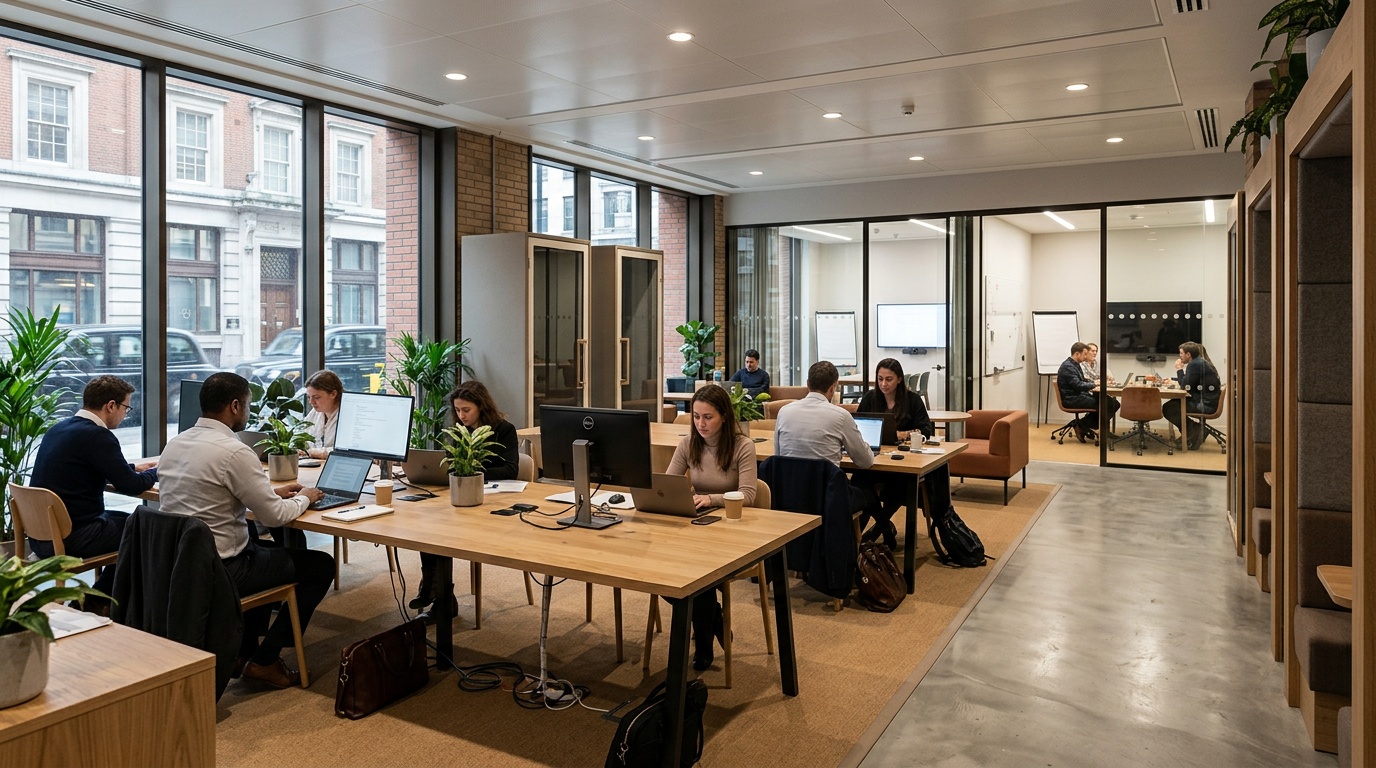




Blackfriars coworking spaces may suit businesses that need a central base without committing to a full office fit-out. Teams can book desks, meeting rooms, or private offices as their headcount and workload change. The financial case is strongest when this flexibility matches real usage rather than replacing a consistently occupied dedicated office.
Location can also affect client access and commuting time. Yet each product has a different utilisation pattern: meeting rooms may sell in concentrated periods, desks may depend on daily demand, and private offices often rely on longer contracts. Forecasting them as one revenue stream can hide weak performance.
How should a business assess a Blackfriars coworking investment?
Start with a property-level forecast, not the prestige of the address. Separate each revenue stream, list recurring and variable costs, calculate break-even occupancy, and test what happens if bookings fall or operating expenses rise.
- Forecast revenue by product. Estimate demand, price, and booking frequency separately for desks, meeting rooms, private offices, memberships, and events.
- List every property cost. Include rent, service charges, business rates, insurance, furniture, utilities, cleaning, staffing, security, software, repairs, marketing, payment processing, and vacancy.
- Calculate break-even occupancy. Identify the utilisation level required to cover fixed costs, then compare it with a realistic demand forecast.
- Review the lease. Check break clauses, rent reviews, repair obligations, permitted use, reinstatement costs, assignment rights, and landlord consent requirements.
- Test downside cases. Model lower occupancy, cancellations, higher utility costs, delayed sales, and shorter customer contracts.
Businesses can compare flexible workspace models and services through options such as premium London business workspace before committing to a location. The right choice is the model that remains workable under conservative assumptions, not only the one with the most visible address.
References
- London Plan 2021
Frequently Asked Questions
What does this article say about investing in Blackfriars coworking spaces?
This article does not establish a Blackfriars-wide return on investment. Investors should verify occupancy, average contract value, operating expenses, lease terms, and cash flow for the specific site.
Which financial metrics should investors review?
Review recurring revenue, revenue per workstation, occupancy, desk utilisation, meeting-room bookings, membership duration, renewal rate, margins, break-even occupancy, and customer concentration.
Mohammad El Shaari
CTO at Hotdesk
Mohammad El Shaari is the CTO of Hotdesk, where he leads the engineering team building and scaling a global SaaS platform for on-demand workspace bookings across 80+ countries. A Computer Science graduate from The British University in Egypt, he brings over a decade of hands-on experience in enterprise software, AI, cloud infrastructure, and cybersecurity.
Before Hotdesk, he served as CTO of Vee Tech, where he led technical delivery for 12+ enterprise clients generating $30M+ in annual revenue, and helped build Egypt’s first innovation lab at Capital International Schools.
At Hotdesk, Mohammad focuses on building scalable systems that handle real-time availability, global user distribution, and high-throughput transactions. He specializes in scalable system design, cloud-native infrastructure, and building high-performance SaaS platforms that support global user bases.
He writes about scaling SaaS platforms, backend architecture, mobile engineering, and real-world technical decisions behind building and operating global products.
Leave a Reply