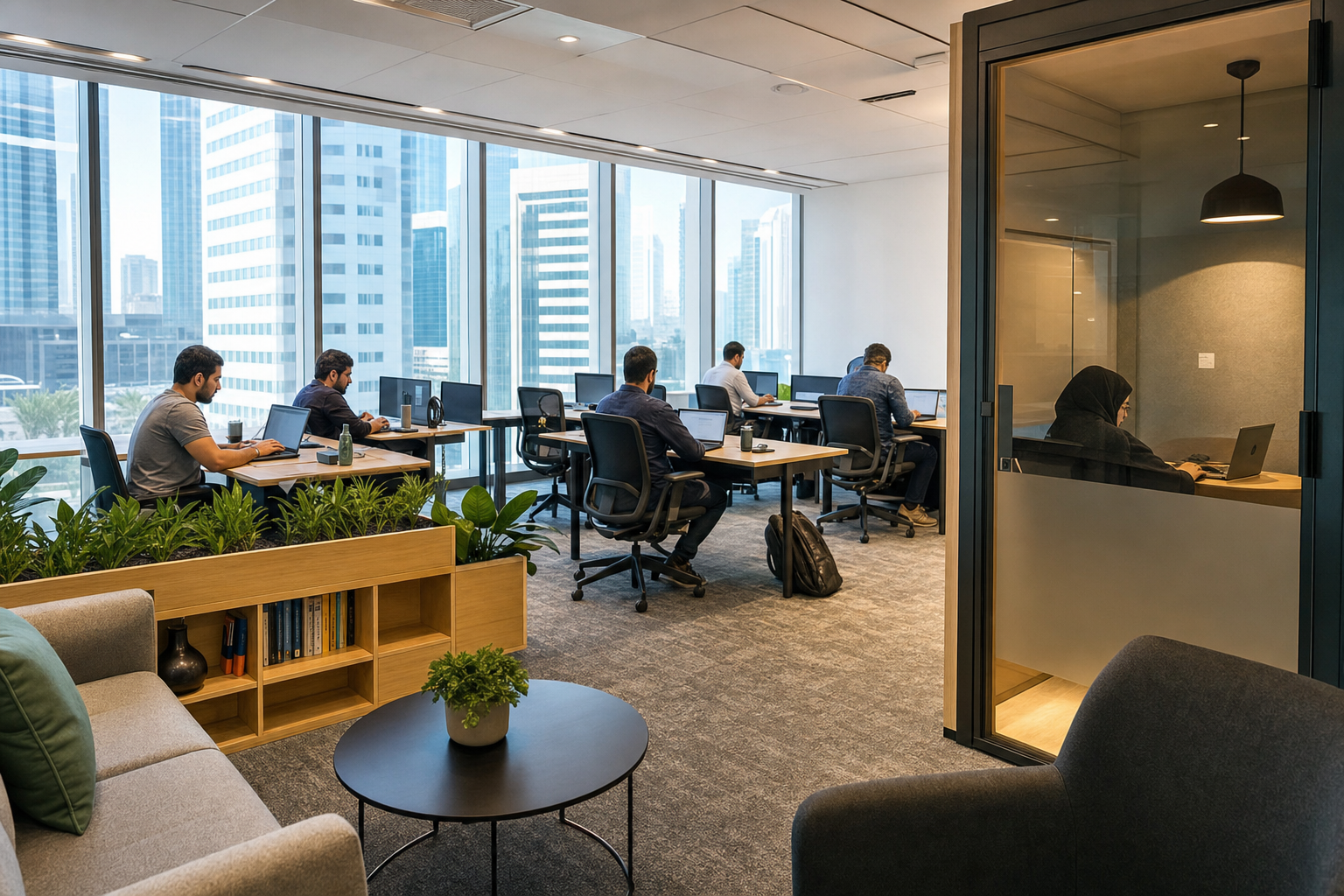
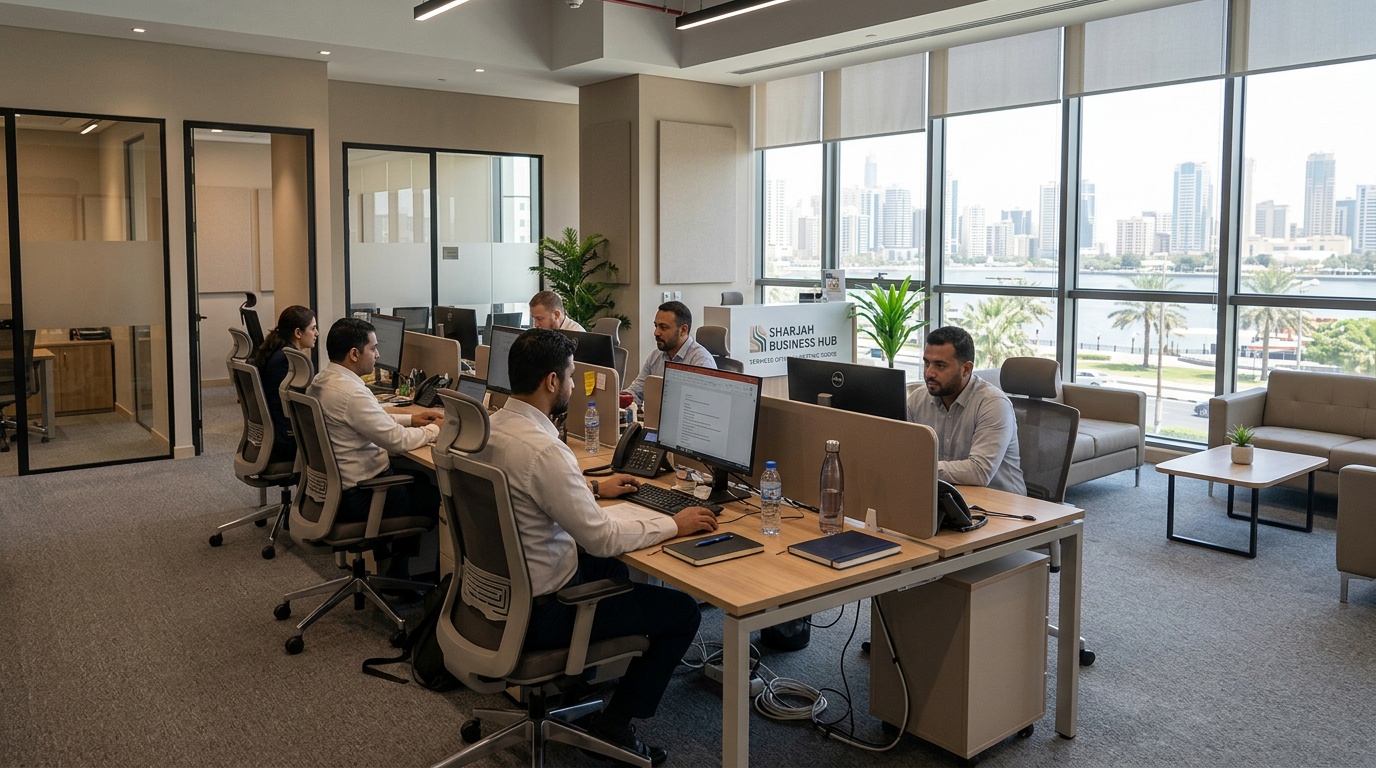
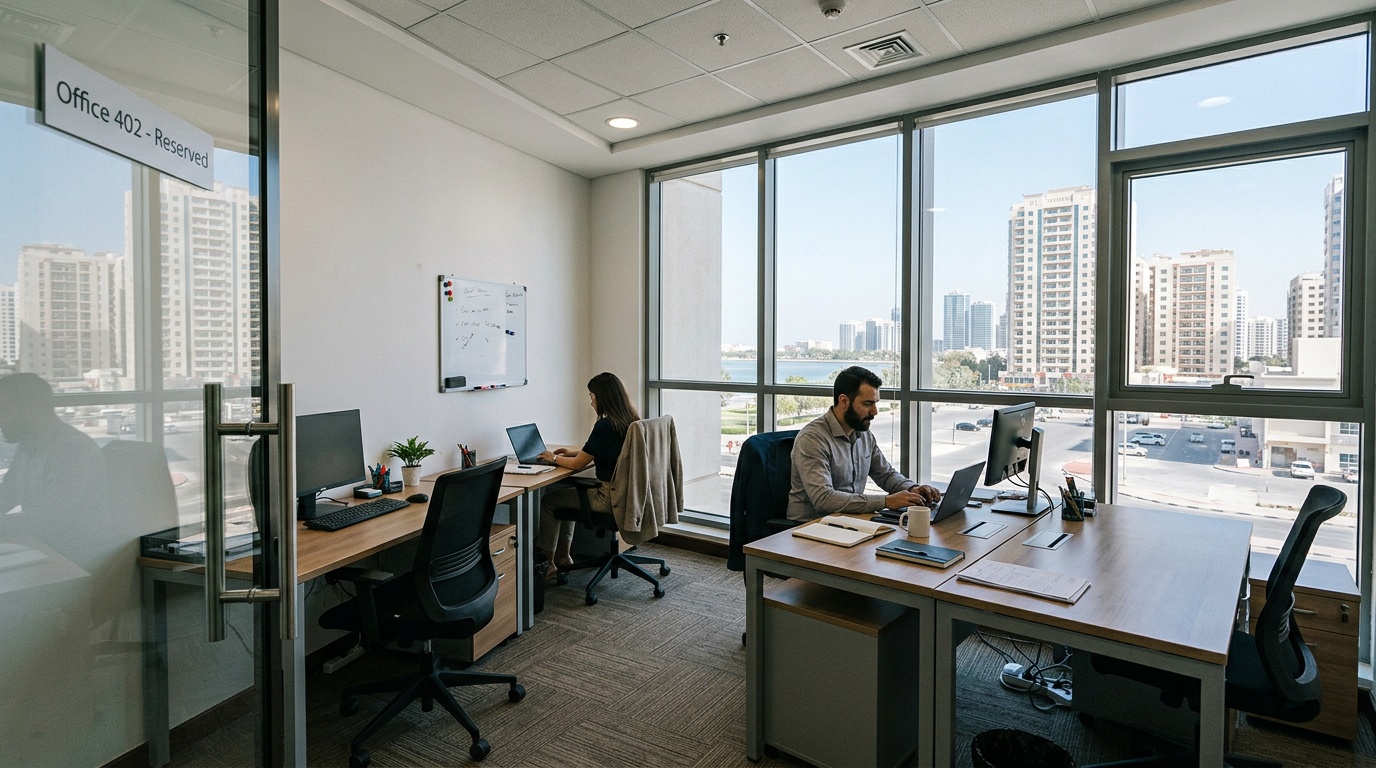
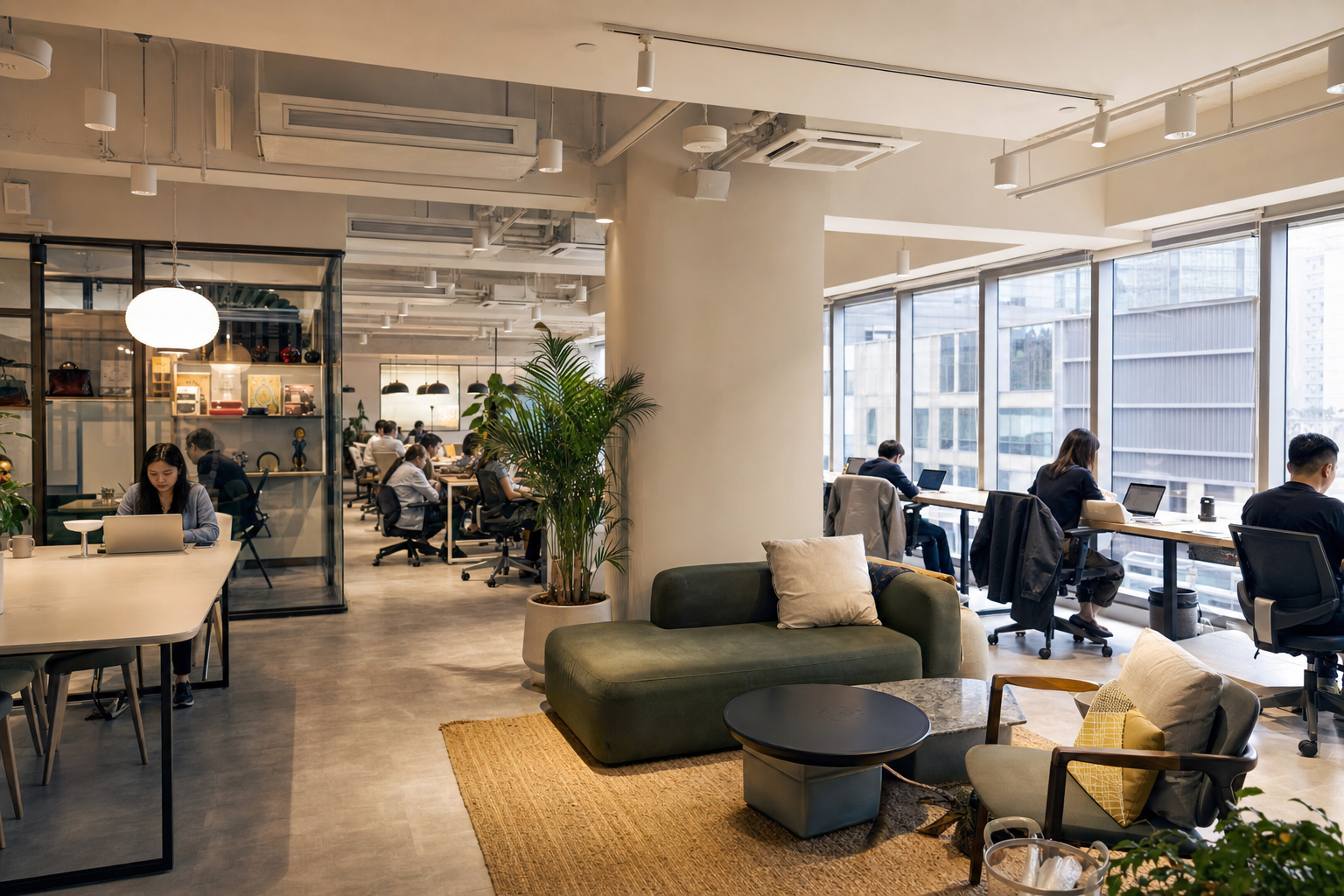
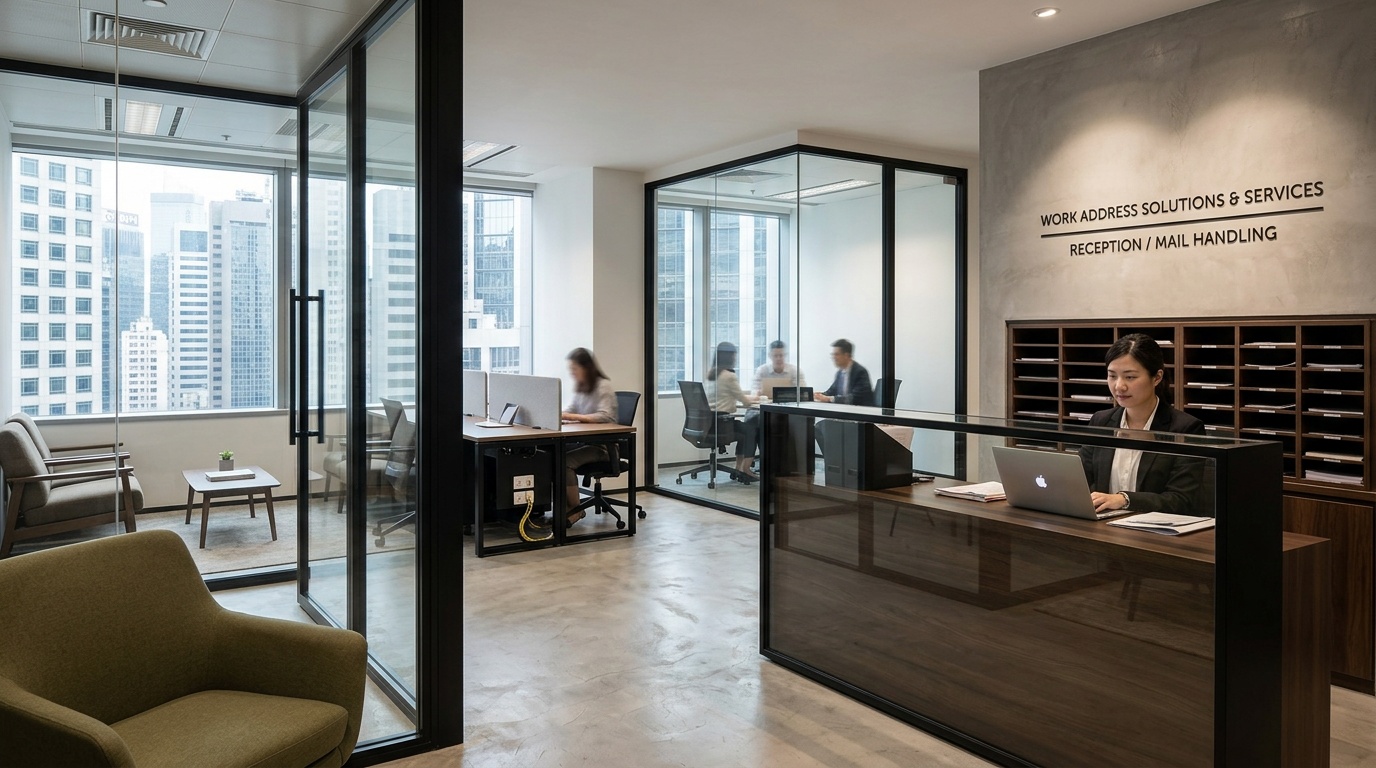
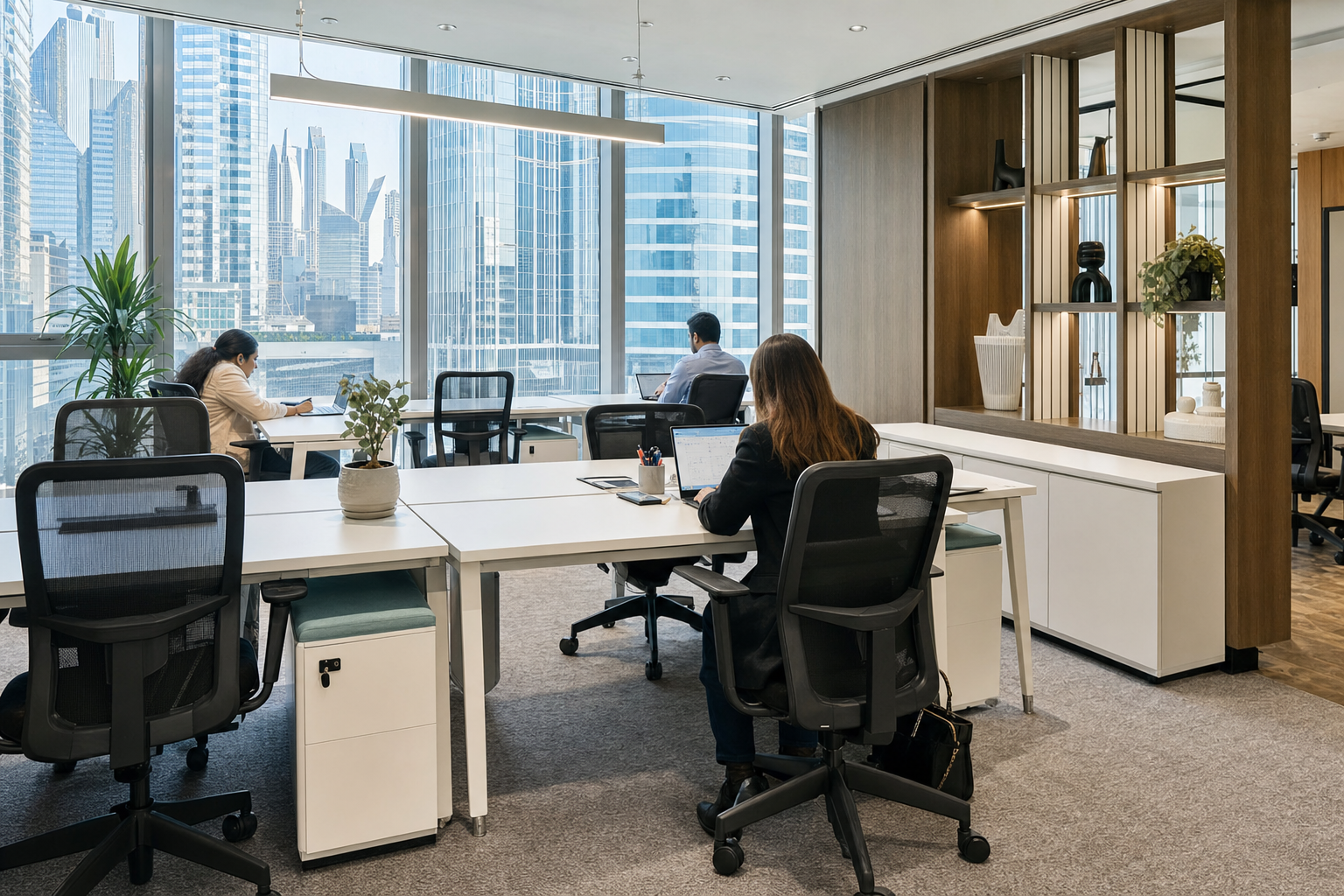
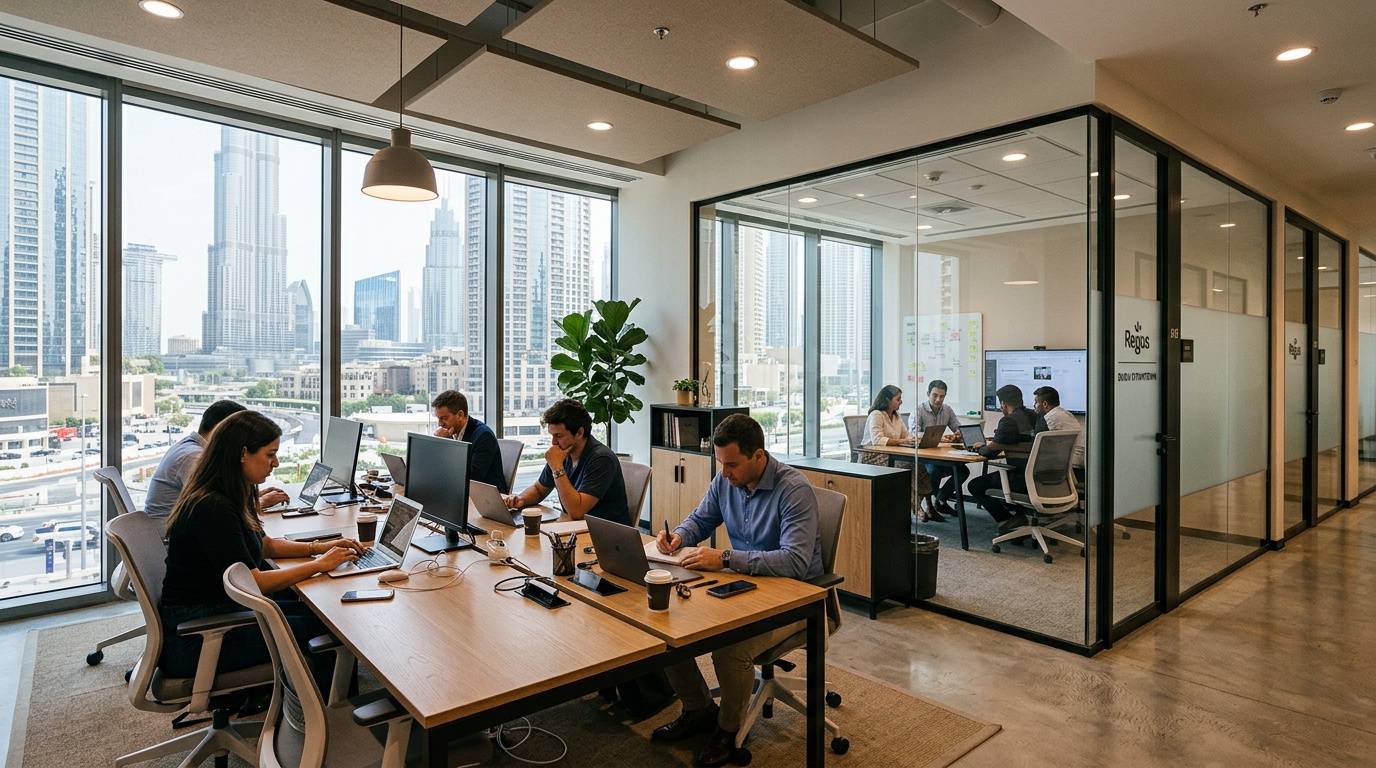
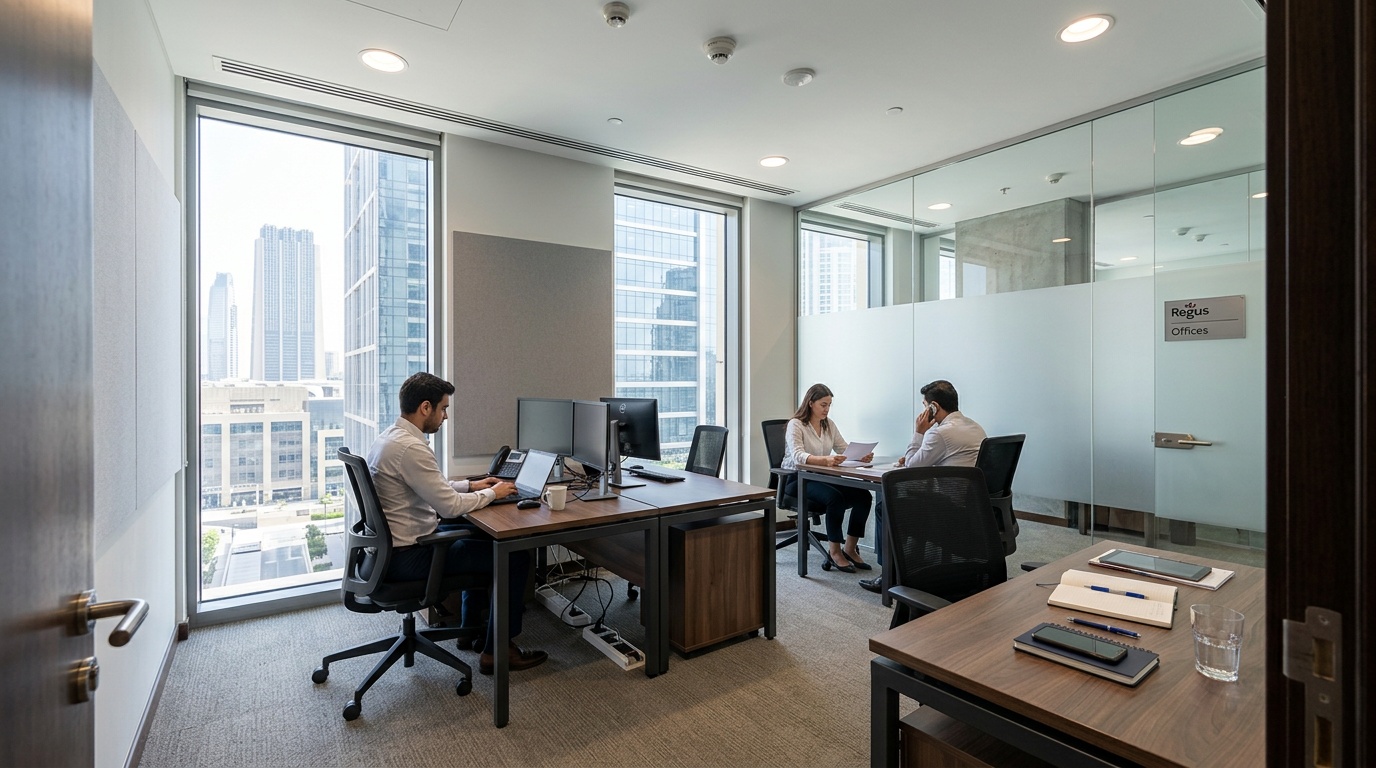
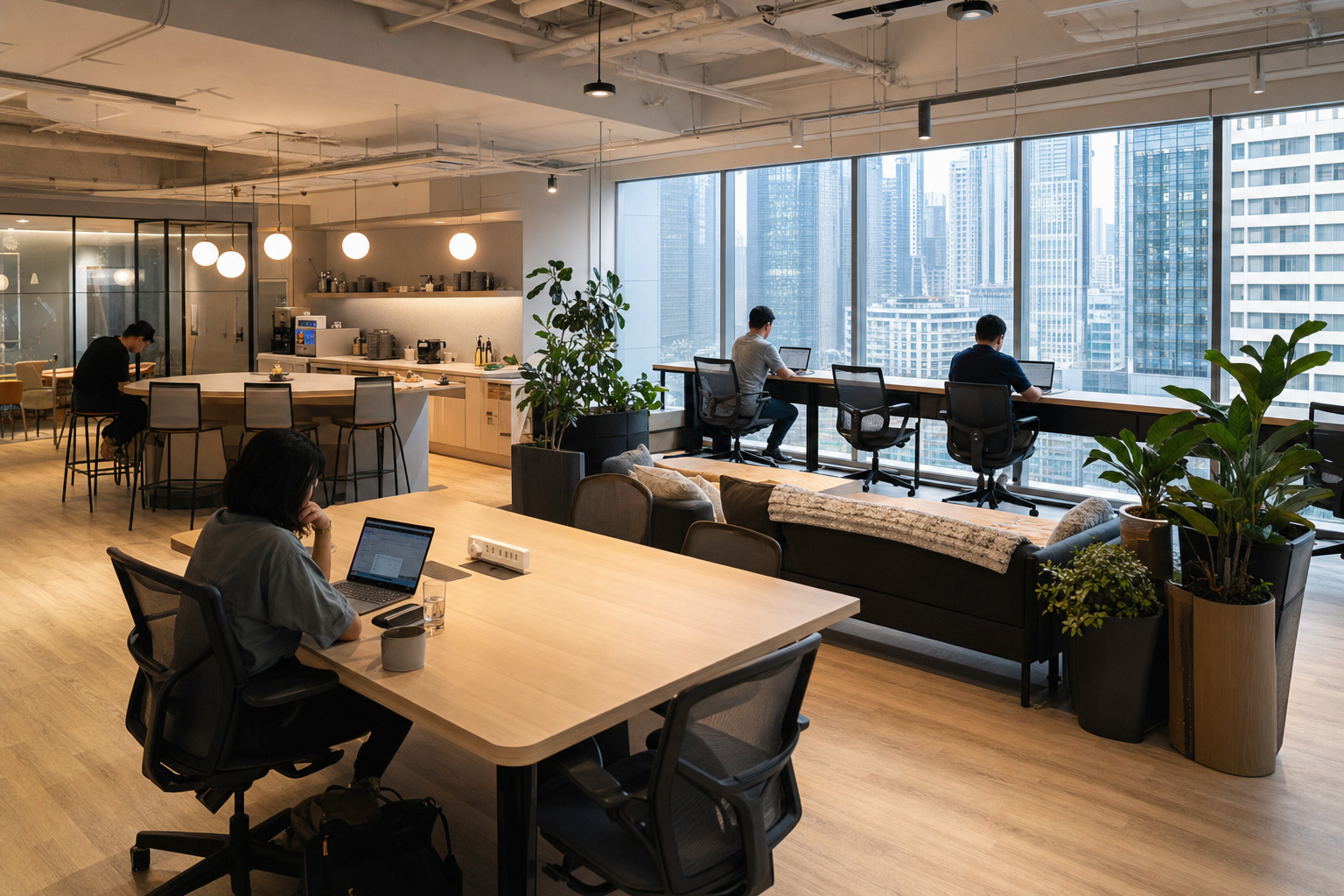
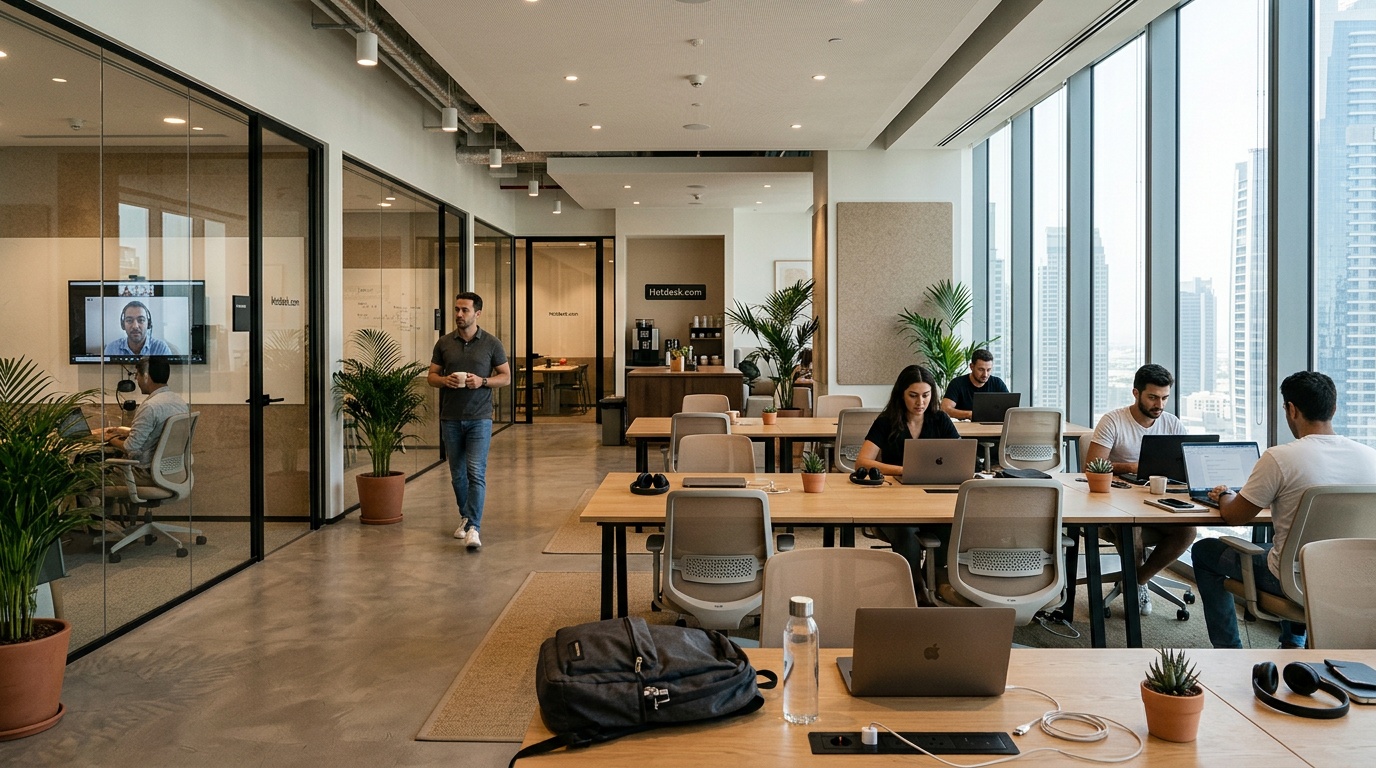
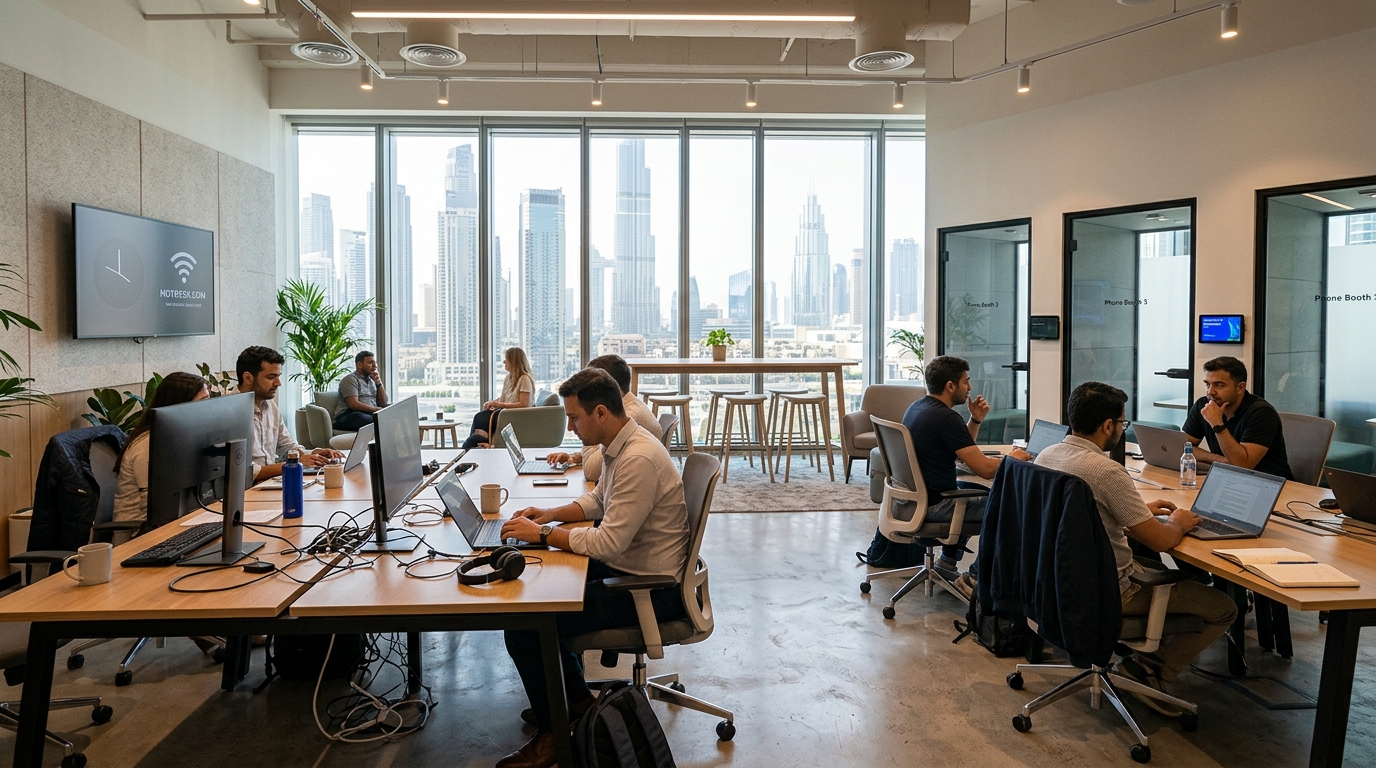
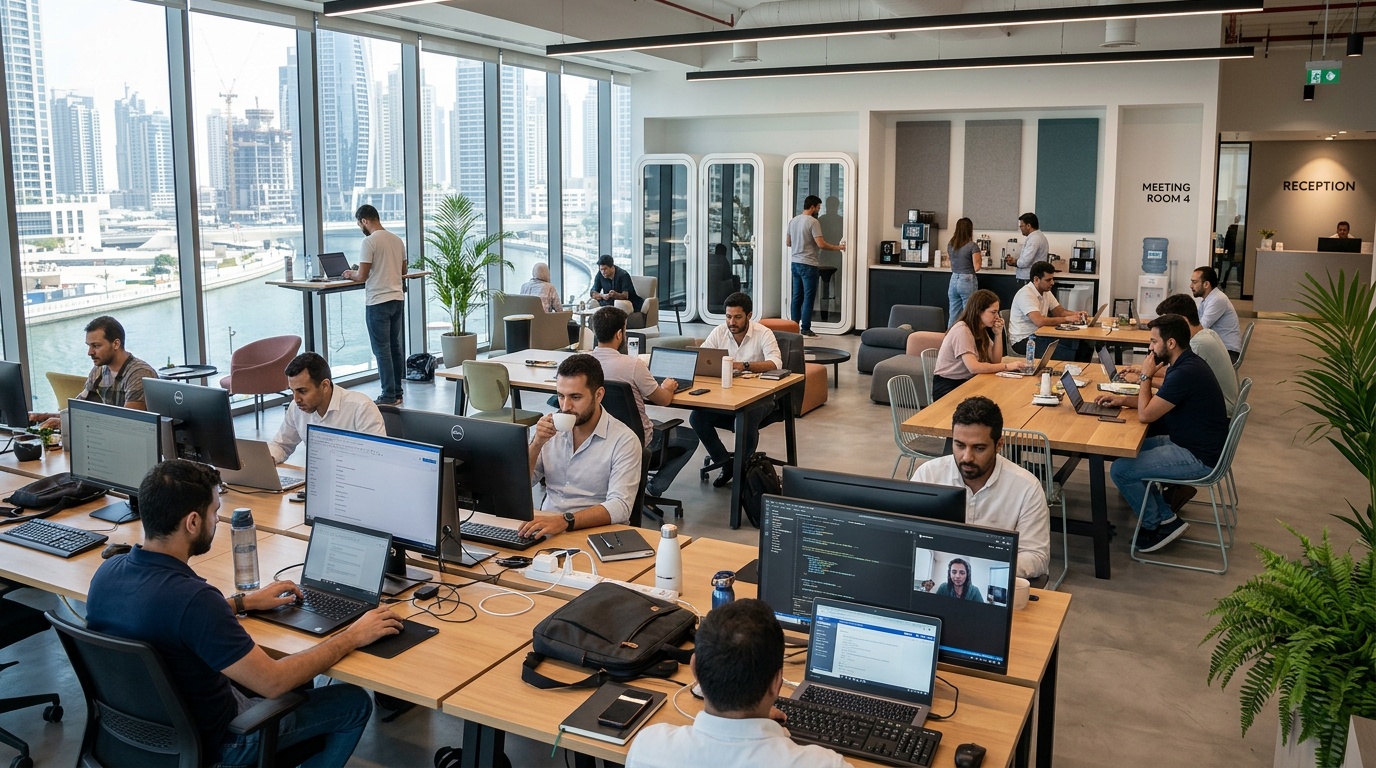
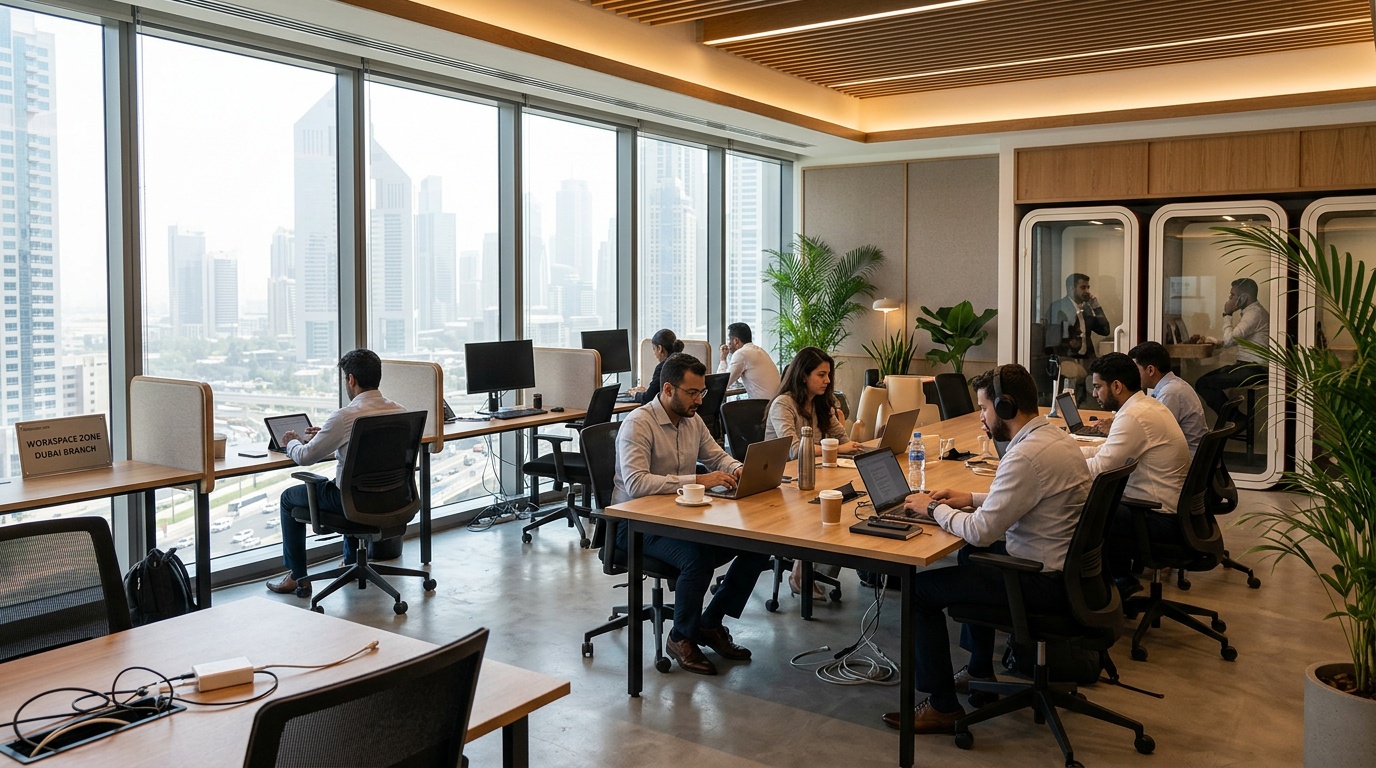
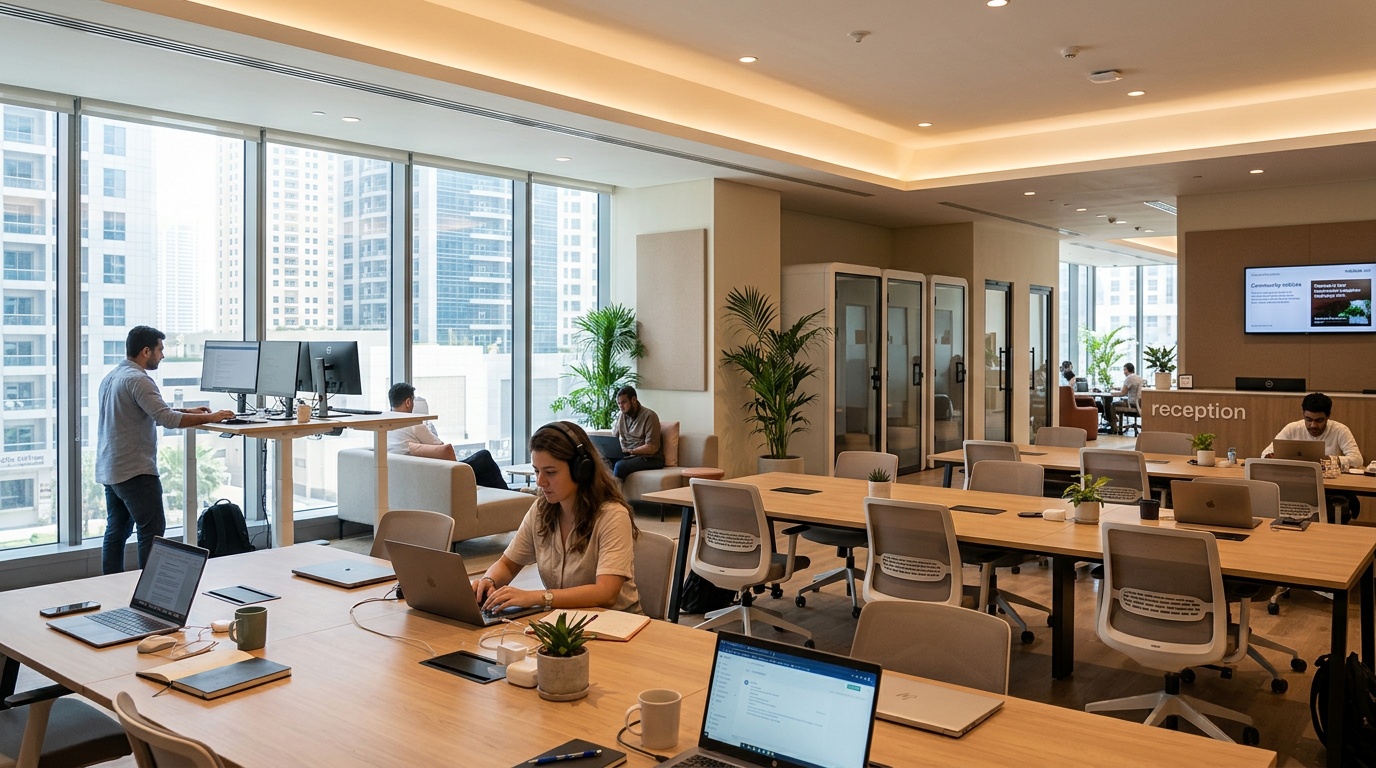
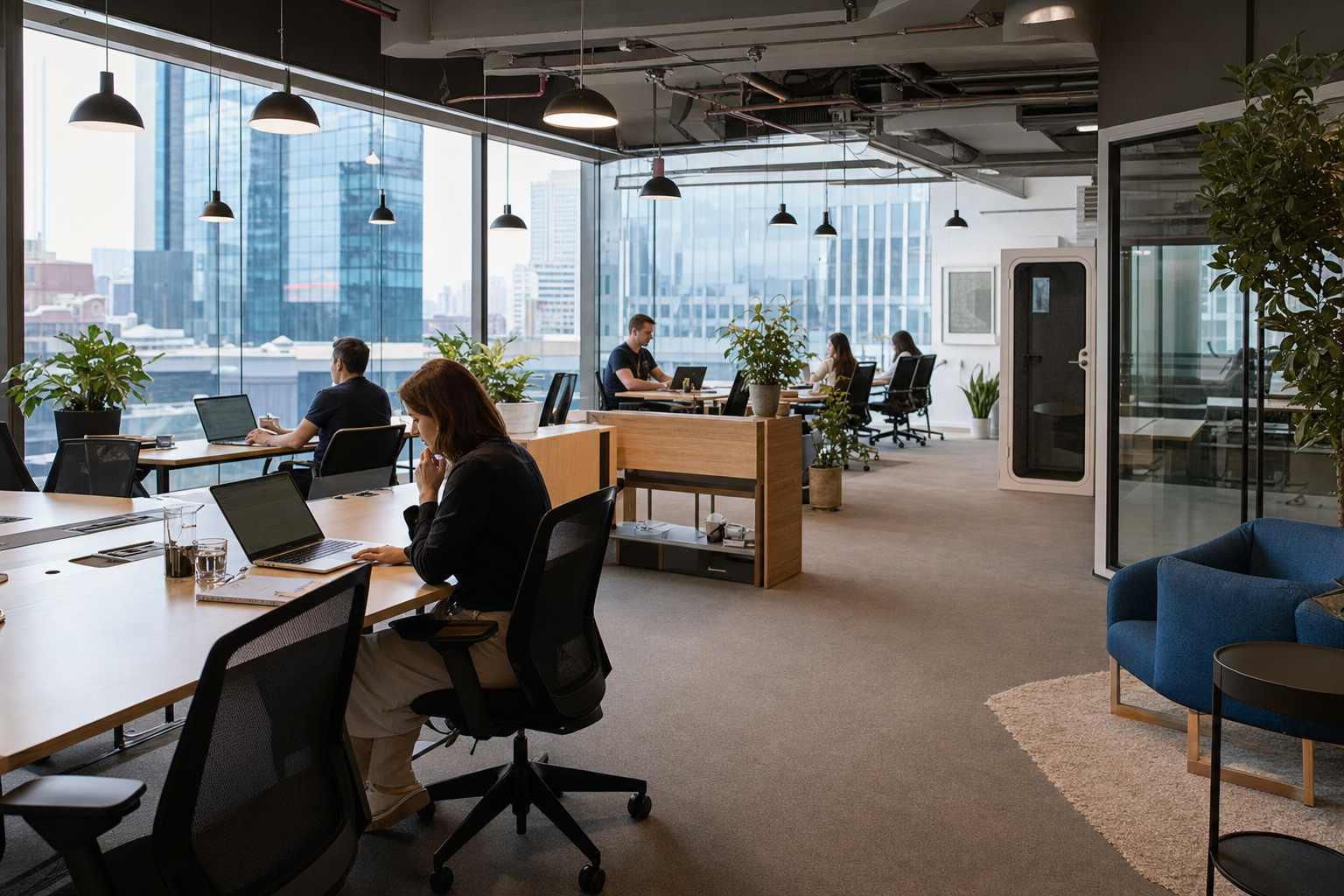
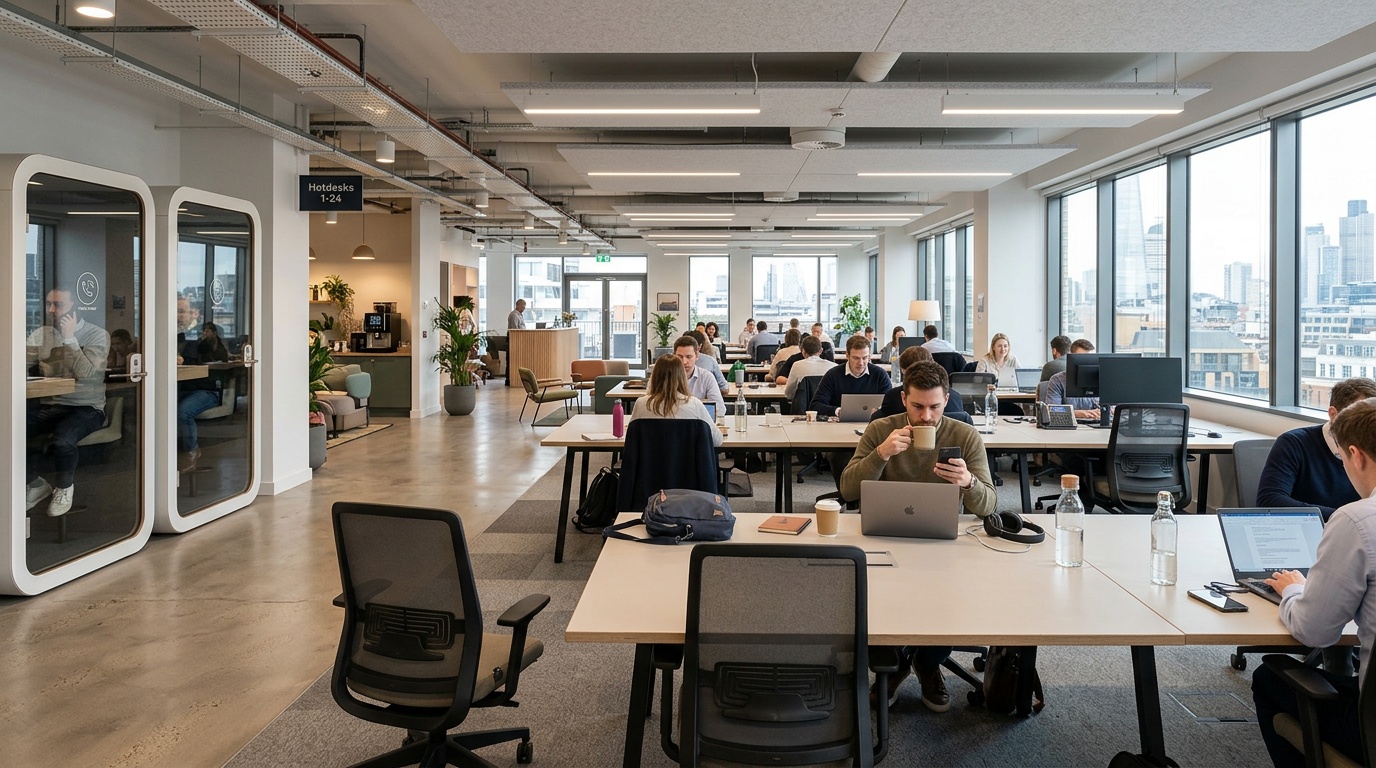
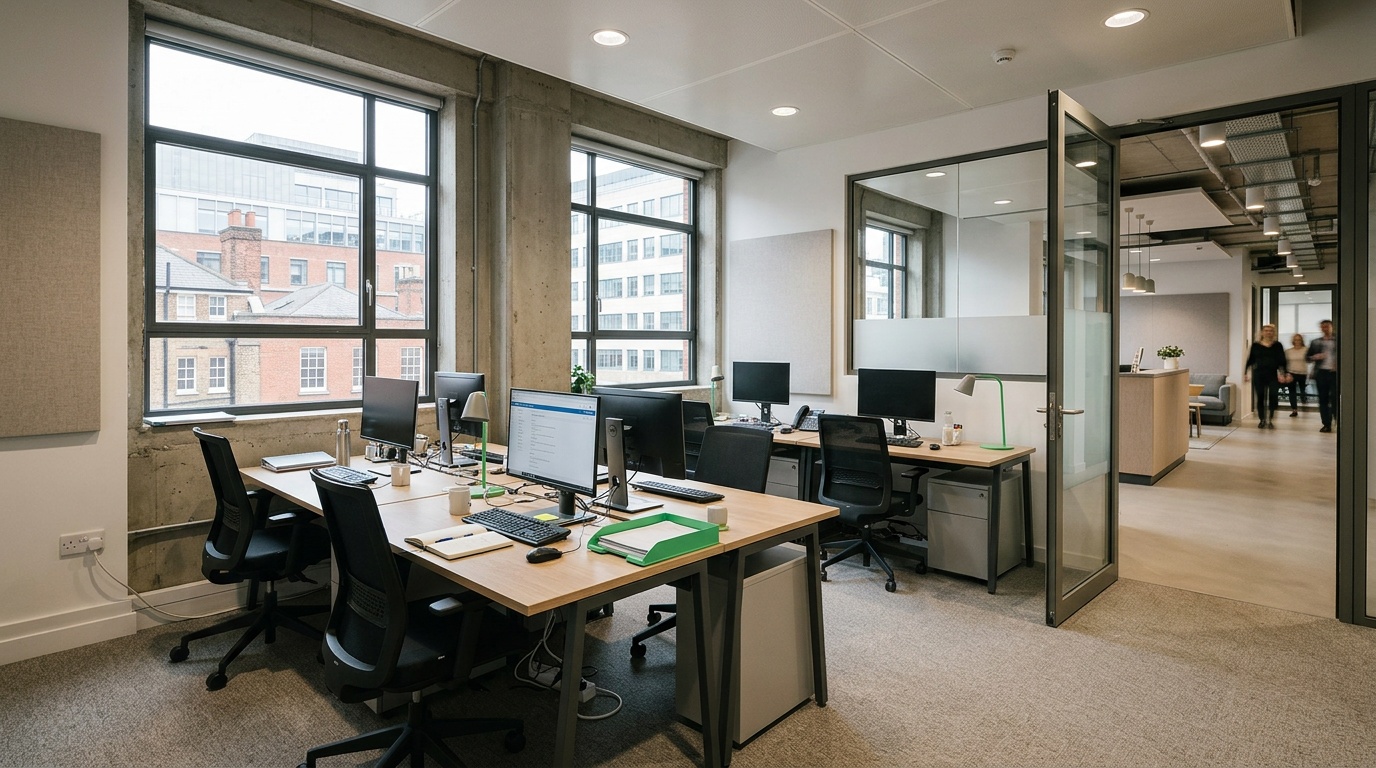
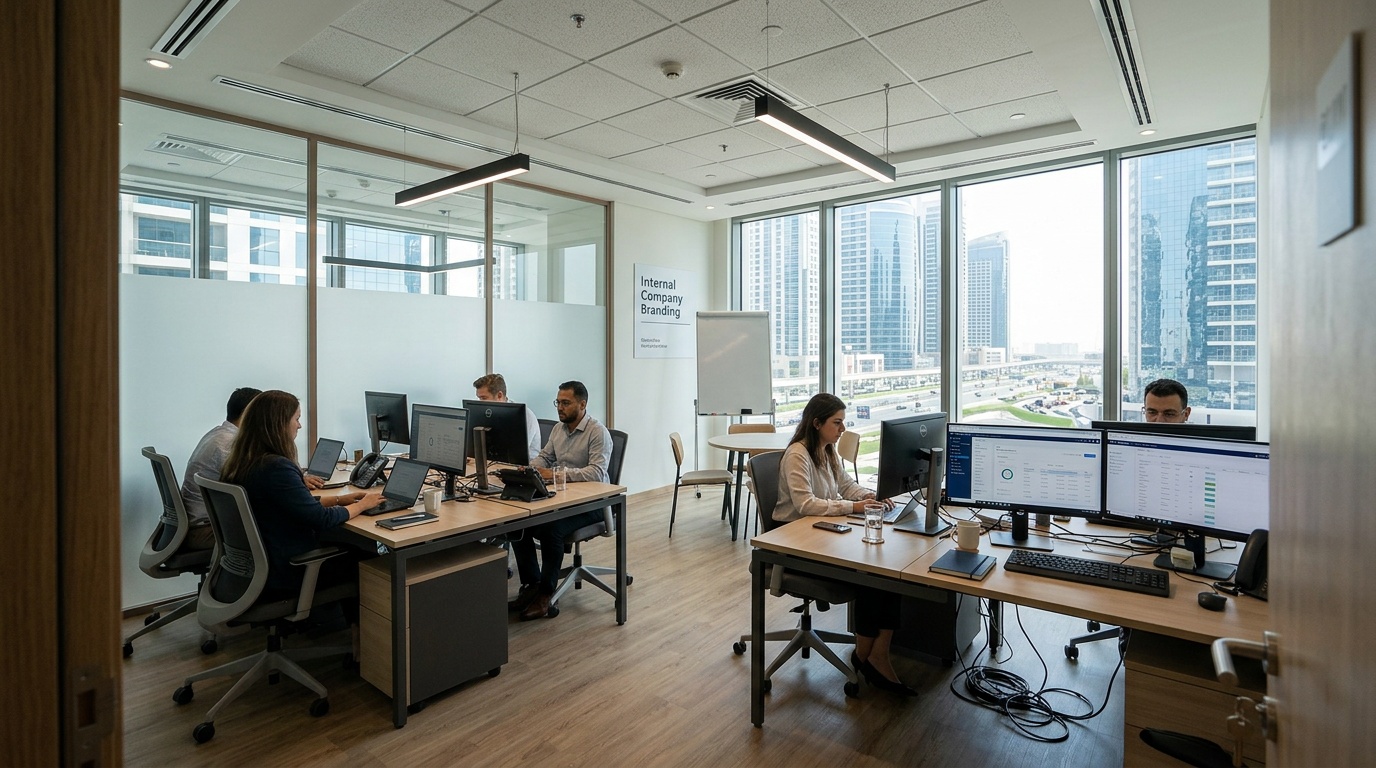
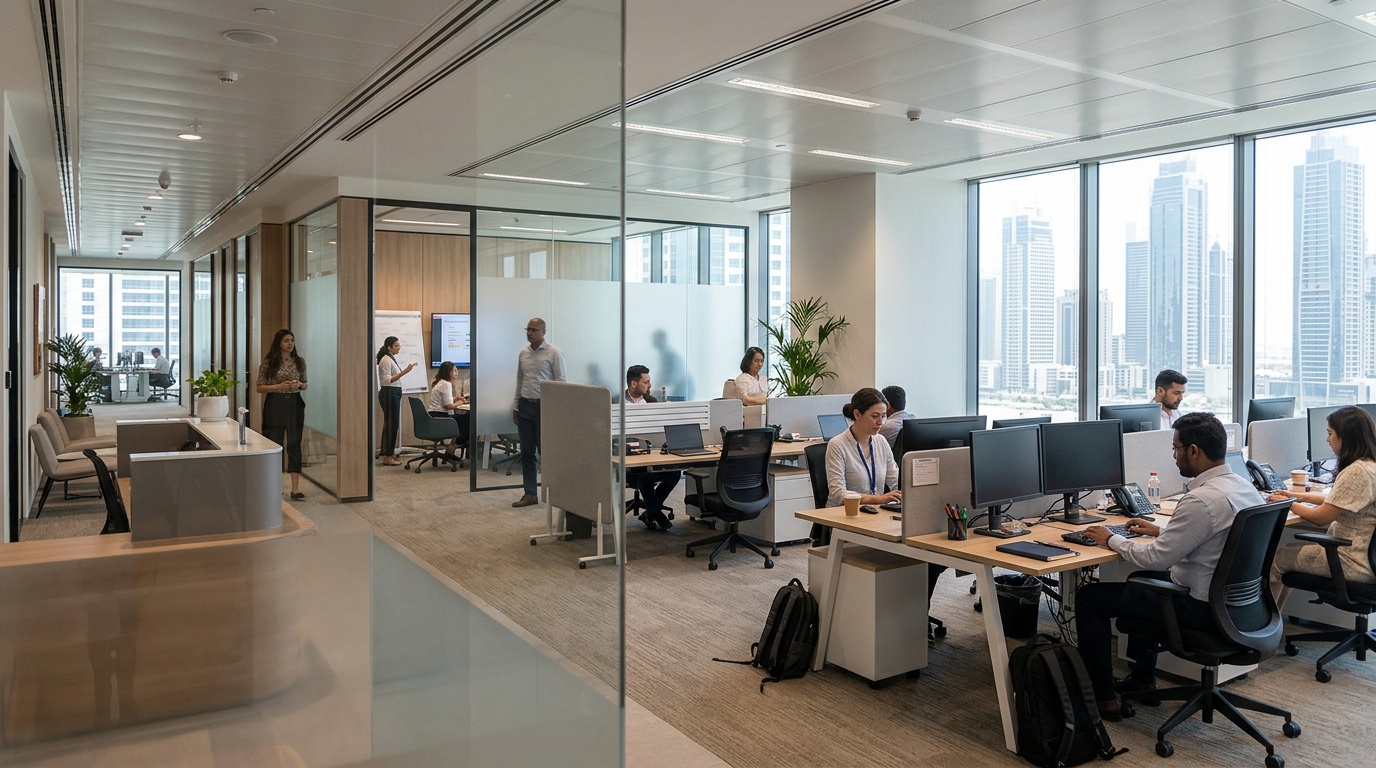
Choosing among Sharjah offices starts with three practical questions: how much space do you need, how often will you use it, and where do your daily routes lead? Sharjah offers traditional leases, serviced suites, coworking desks, virtual addresses, and meeting rooms, allowing startups, consultants, remote workers, and established teams to match workspace costs to actual use.
Key Takeaways
Sharjah’s office market lets you match costs to actual usage by choosing from traditional leases, serviced suites, coworking desks, virtual addresses, or meeting rooms.
Your daily commute and preferred routes should guide your choice of area, not just the price per square foot.
Virtual addresses and meeting rooms give you a professional presence without committing to a full-time physical office.
Startups and remote workers can start with coworking desks or serviced suites and scale up as their team grows.
Aligning workspace costs with how often you actually use the space helps you avoid paying for empty desks or unused square footage.
The best option isn’t always the largest room. A two-person team may need furnished desks and reliable Wi-Fi, while a company registering locally may need a dedicated office, tenancy documentation, reception support, and meeting facilities.
Types of Sharjah Offices and What They Cost
Sharjah office rent commonly ranges from AED 35,000 to AED 150,000 per year, based on asking-price listings. District, floor area, furnishing, parking, fit-out, lease term, and included services all affect the final amount, so treat this range as an initial reference rather than a quote.
Private and Serviced Offices
A private office gives your team a defined room for confidential work, equipment, files, and client meetings. Serviced offices may include furnishings, reception, internet, cleaning, and shared amenities within one recurring payment.
Coworking Spaces and Hot Desks
Coworking spaces provide a professional setting without a full-time private suite. A hot desk is usually a bookable workstation in a shared area, while a dedicated desk gives you a consistent seat.
Virtual Offices and Meeting Rooms
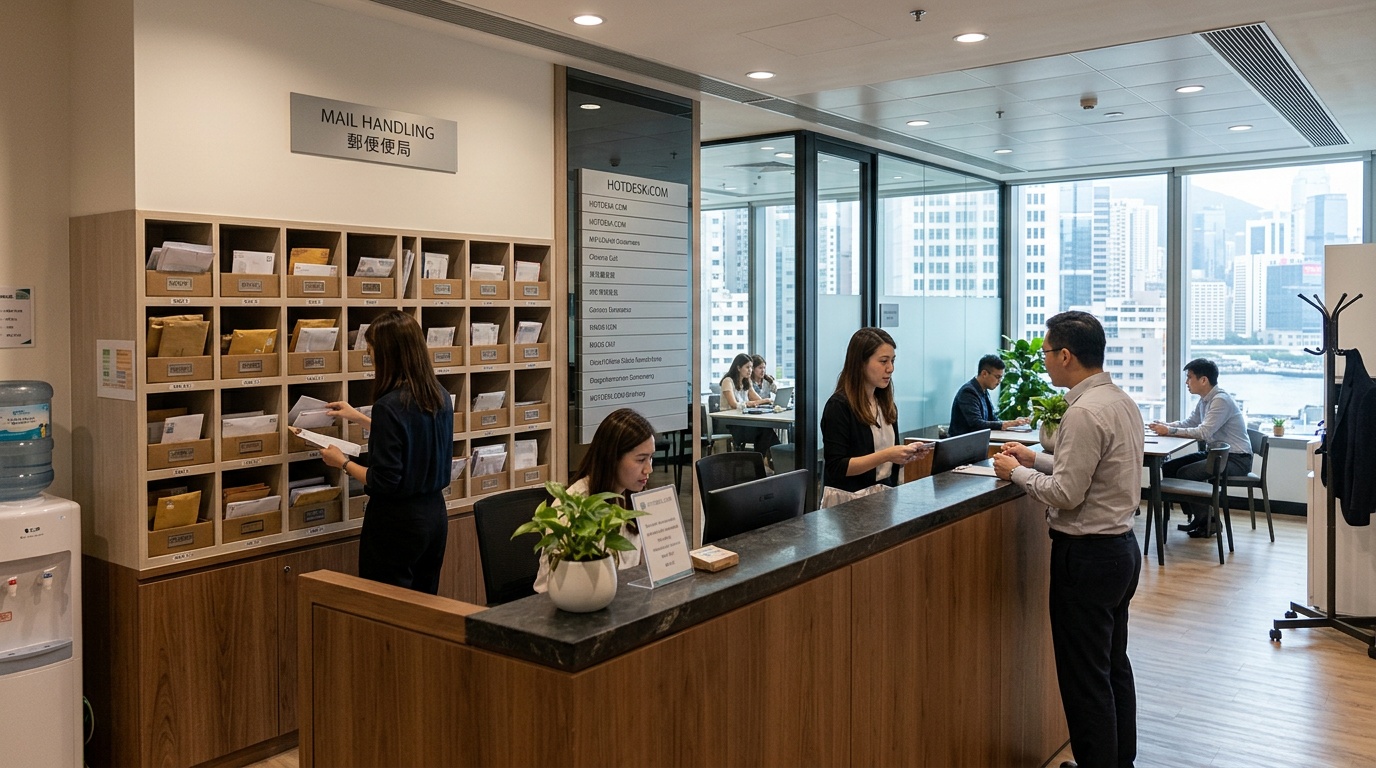
A virtual office can provide a business address, mail handling, or occasional administrative support without a permanent workstation. Meeting rooms suit interviews, presentations, workshops, and client appointments.
Workspace format
Best fit
Typical cost structure
Private or serviced office
Teams needing privacy
Annual lease or monthly payment
Coworking or hot desk
Independent workers and flexible teams
Daily pass or monthly plan
Virtual office
Businesses needing an address
Recurring service fee
Meeting room
Remote teams
Hourly or daily booking
Key Business Districts in Sharjah for Your Workspace
The right Sharjah district depends on who needs to reach the office and what the business does there. Waterfront areas suit client-facing teams, Al Nahda helps employees commuting from Dubai, and SAIF Zone supports companies tied to logistics, warehousing, and airport routes.
Al Majaz, Al Qasba, and Al Khan
Al Majaz places offices near residential towers, retail, restaurants, and public amenities. Al Qasba offers a compact mixed-use setting, while Al Khan combines commercial activity with residential access.
SAIF Zone and Al Nahda
The Sharjah Airport Free Zone suits companies that need cargo routes, airport services, warehousing, or free-zone infrastructure. Al Nahda offers residential density, retail services, and road connections close to Dubai.
Location map description: Picture Sharjah in three practical bands: waterfront districts for client access, the Al Nahda corridor for Dubai-facing commutes, and the airport-side zone for trade and logistics.
Sharjah Offices vs. Dubai: The Real Trade-Off
The choice between Sharjah and Dubai depends on occupancy cost, employee access, and client proximity. Sharjah rent may leave more budget for hiring, equipment, licensing, or additional floor area. Dubai can make sense for teams needing daily access to financial districts or premium client addresses.
Cost Savings and Infrastructure
Include deposits, utilities, service charges, furniture, parking, registration, and employee travel in the calculation. A lower lease cost only helps if the team can reach the office without losing valuable time.
The Sharjah-to-Dubai Commute
Test routes from employee residences at actual start and end times. Check parking, toll exposure, bus connections, and the walk from the building entrance to the main road.
How to Avoid Broker Scams and Hidden Fees in Sharjah
Verify the property, representative, and payment terms before committing. An unusually low price, pressure to transfer money, vague photographs, or refusal to provide a building name should pause the process.
Ask for the complete building name, suite number, district, and map location.
Request a live video tour or visit the property.
Request a written quotation separating rent, deposit, commission, tax, utilities, maintenance, parking, and access charges.
Confirm the permitted business activity, tenancy documentation, renewal terms, and refund policy.
Pay only through a traceable method to the verified contracting entity.
Securing Short-Term and Flexible Office Space in Sharjah
Short-term workspace suits consultants, visiting executives, newly formed companies, distributed teams, and temporary projects. It avoids the deposit, furniture purchase, utility setup, and long commitment attached to a conventional lease.
Check internet reliability, reception, power access, quiet areas, phone booths, meeting rooms, printing, parking, and cancellation terms. Choose the shortest commitment that supports the work.
Hotdesk lets users search available workspaces, review amenities, choose access dates, and pay for the booking without a membership fee. Confirm the exact address, floor, access instructions, Wi-Fi arrangements, working hours, refund policy, and included facilities before payment.
Recommendation: Start with a day pass or short booking while assessing an area, testing a commute, or supporting a temporary project. Move to a recurring arrangement only after the workspace proves suitable.
Coworking spaces are typically priced through daily passes, monthly plans, or dedicated desk memberships. Check whether internet, lockers, meeting-room credits, visitor privileges, taxes, and service charges are included.
Which areas in Sharjah are best for renting office space?
Al Majaz, Al Qasba, and Al Khan offer waterfront access, while Al Nahda provides close access to Dubai and SAIF Zone supports logistics and airport-related businesses.
What should I check before signing an office lease in Sharjah?
Confirm whether utilities, furniture, parking, maintenance, and registration paperwork are included or charged separately. Compare the total monthly expense rather than only the advertised rate.
Mohamed Khaled is the Founder and CEO of Hotdesk, the on-demand workspace platform providing access to coworking spaces and flexible offices across more than 120 countries.
He spent nearly a decade at PwC before moving into financial leadership at SWVL, where he led the company’s $1.5 billion Nasdaq listing, the first Unicorn from thr Middle East to go public in the United States.
A Forbes 30 Under 30 honoree, Mohamed built Hotdesk from a side project into a global platform, leading a team of more than 50 and expanding into international markets, including the acquisition of Spain-based coworking marketplace YADO.
Also being Co-founder and President of DESK Token, the world’s first asset backed property investment and utility hybrid token, Mohammed is focused on building infrastructure that unlocks underutilized assets – from meeting rooms to private offices and full on buildings – while creating space for the future of work.
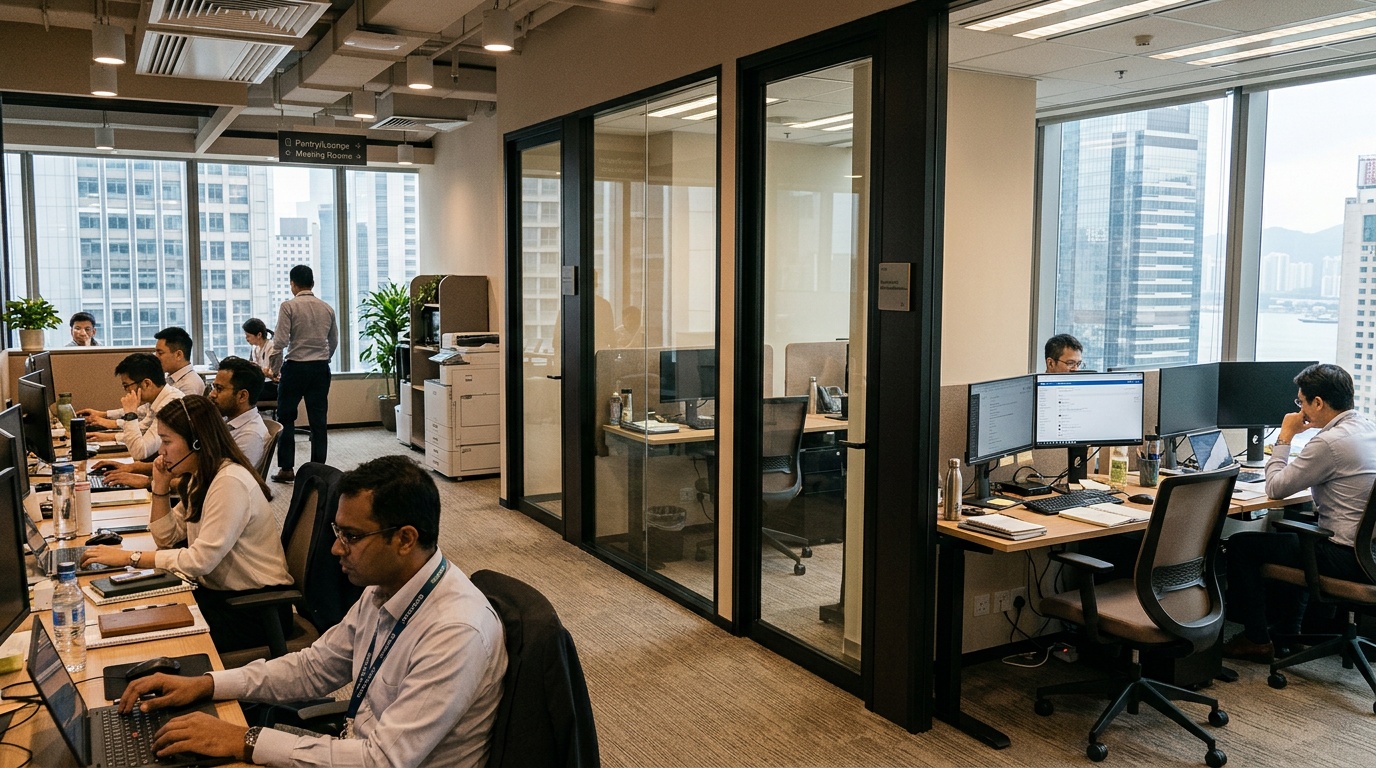
Industry expert picks for the most productive coworking spaces in Hong Kong.
The most productive coworking space in Hong Kong is the one that keeps your work moving: stable internet, reachable power, suitable acoustics, and access that fits your day. Choose based on the work you need to complete, the people you need to meet, and the time you can spend travelling.
Key Takeaways
Ever wonder why some spaces boost output while others drain your energy? The answer lies in foundational infrastructure like stable power and reliable internet.
Productivity depends on matching the environment to your specific tasks, whether you need deep focus or active collaboration.
Minimizing travel time is essential for maintaining momentum throughout your workday.
Selecting a space with suitable acoustics ensures you can concentrate without constant distractions.
Your choice of workspace should always align with the people you need to meet and the goals you must achieve.
Hong Kong’s density makes location part of the productivity calculation. A central workspace may suit client meetings, while a location closer to home can preserve time for concentrated work. Hourly and daily booking options let you choose without taking on a long-term lease.
What makes a coworking space productive in Hong Kong?
A productive coworking space gives you the physical and technical conditions needed for the task at hand: stable connectivity, a usable desk, power, appropriate noise levels, and private areas for calls. A developer working through a long build has different needs from a consultant moving between client meetings.
Review the operating details, not just the photographs. Confirm what the booking includes, such as desk access, printing, coffee, lockers, visitor handling, meeting-room credits, and entry during your intended hours.
Professionals comparing local options can review a Hong Kong business centre and confirm its current facilities and access terms when they need a professional setting.
What are the benefits of productive coworking spaces?
The main benefit is a dedicated setting for focused work. A proper desk, dependable connectivity, and a clear boundary from home or public spaces can make it easier to protect a block of concentration.
Flexible access also lets you choose a location around the day you actually have. A central district can shorten the gap between client appointments; a neighborhood workspace can reduce the time spent crossing the city. Check the available booking period before relying on either option.
One visit may include several work modes. You might need a quiet desk for analysis, a booth for a client call, and a larger room for a planning session. Check for those facilities before paying for access.
For teams seeking a flexible option in the city, The Work Project Midtown can be considered alongside other Hong Kong workspaces, subject to confirmation of its current availability and facilities.
How should you choose a productive coworking space in Hong Kong?
Start by listing the work your visit must support. Include focused writing, software development, financial analysis, video calls, design work, team planning, or travel between appointments. That list gives you a practical filter for every workspace listing.
Then test the location against your schedule:
Check the walking route from the MTR station and the building’s entry process.
Confirm opening hours, elevator access, accessibility, air conditioning, and nearby food options.
Verify Wi-Fi, power outlets, desk comfort, printing, kitchen access, lockers, booths, and meeting-room credits.
Review the price, cancellation rules, deposits, membership requirements, and payment method.
If possible, book a trial visit and run a video call, upload a file, and complete a concentration-heavy task.
A trial reveals constraints that a listing may not show. Does the desk stay comfortable after two hours? Can you hear nearby calls? Is the upload stable at the time you work? Those details determine whether the space will support a repeatable day.
Good workspace selection is a continuity problem: the fewer things you need to reconfigure, the more attention stays on the work. Compare transit, entry, connectivity, privacy, ergonomics, and payment terms. A workspace such as H Code shows why the surrounding environment and intended work mode should be assessed before booking; confirm its current features and terms in the listing.
How should you assess productive coworking spaces in Hong Kong?
They should be assessed using operating criteria rather than a fixed ranking. A productive workspace provides dependable internet, accessible power, suitable seating, private call areas, meeting facilities, clear check-in instructions, and a suitable noise policy.
What specific features make a coworking space productive?
Stable Wi-Fi, power outlets, ergonomic seating, adequate desk depth, controlled lighting, comfortable temperature, phone booths, enclosed rooms, and reliable meeting technology support productive work.
Which areas in Hong Kong may suit productive work?
The suitable area is the one that fits your commute, appointments, and work rhythm. Consider walking distance from the MTR, entry procedures, opening hours, lunch options, and the location of your next meeting.
How should I assess the cost of a productive coworking space in Hong Kong?
Assess the price alongside access hours and included services.
How do I choose a coworking space that fits my work style and industry?
Map your primary tasks to the workspace environment, then test the space during normal working hours whenever possible. The durable standard is simple: the space should preserve focus, access, and continuity with minimal reconfiguration.
Mohammad El Shaari is the CTO of Hotdesk, where he leads the engineering team building and scaling a global SaaS platform for on-demand workspace bookings across 80+ countries. A Computer Science graduate from The British University in Egypt, he brings over a decade of hands-on experience in enterprise software, AI, cloud infrastructure, and cybersecurity.
Before Hotdesk, he served as CTO of Vee Tech, where he led technical delivery for 12+ enterprise clients generating $30M+ in annual revenue, and helped build Egypt’s first innovation lab at Capital International Schools.
At Hotdesk, Mohammad focuses on building scalable systems that handle real-time availability, global user distribution, and high-throughput transactions. He specializes in scalable system design, cloud-native infrastructure, and building high-performance SaaS platforms that support global user bases.
He writes about scaling SaaS platforms, backend architecture, mobile engineering, and real-world technical decisions behind building and operating global products.
What do Hong Kong business consultants recommend for flexible office solutions?
Hong Kong rewards businesses that can move quickly, yet its office market often asks founders to make long commitments before their revenue, headcount, or local strategy is clear. What flexible office approach can suit Hong Kong businesses? A practical approach is to match the workspace to the stage of the business, using an address, desk, meeting room, or private suite only when the operation needs it.
Key Takeaways
Hong Kong rewards businesses that can move quickly, yet its office market often asks founders to make long commitments before their revenue, headcount, or local strategy is clear.
What flexible office approach can suit Hong Kong businesses?
A practical approach is to match the workspace to the stage of the business, using an address, desk, meeting room, or private suite only when the operation needs it.
This approach protects cash flow while giving a company a credible base in the city. It also supports remote workers, non-local talent, and distributed teams that need somewhere professional to work without rebuilding their setup each time they arrive.
How Flexible Workspaces Lower Barriers to Entry in Hong Kong
The Weight of Traditional Commercial Leases
A conventional office lease can place several demands on a new company at once: a security deposit, advance rent, furniture, internet installation, insurance, business registration paperwork, and a commitment that may outlast the original business plan. In central commercial districts, rent is only one part of the calculation. A founder also pays for unused desks, reception coverage, cleaning, utilities, maintenance, and the time required to manage a physical site.
That fixed cost structure is difficult for a solo consultant, early-stage startup, or overseas team testing demand in Hong Kong. Market conditions can change before a long lease reaches its midpoint. A company may need a Mandarin-speaking meeting environment one month, a Cantonese-capable local contact the next, and a temporary project room after that. Traditional premises rarely adjust at the same speed.
On-Demand Booking as an Equalizer for New Founders
Flexible offices separate access from permanent occupancy. A founder can start with a professional business address, reserve a conference room for client meetings, and book a desk only on the days that require focused work. This reduces upfront exposure and keeps workspace spending closer to actual usage. Flexible commitments can suit startups that need to adapt their workspace arrangements as business needs change.
The savings can be meaningful. A virtual office and on-demand meeting rooms may reduce rent and utility costs compared with maintaining a full-time office. The right setup also gives a new founder a reliable routine: a known place to take calls, meet partners, store work materials, and operate with greater confidence.
Comparing Recommended Solutions: Virtual, Coworking, and Private Offices
What flexible office approach can suit Hong Kong businesses? Begin with the work pattern, not the room itself. A virtual office suits a company that needs a local address and administrative presence. Coworking supports people who need mobility and occasional interaction. A managed private office fits teams that require privacy, control, and a consistent base.
Virtual Offices for Compliance and Corporate Legitimacy
Virtual-office services vary by provider and may include a business address, mail handling, call support, and access to meeting rooms when physical appointments arise. Confirm the available services before booking. A provider cannot replace professional legal or accounting advice, and registration requirements should be confirmed with the relevant Hong Kong authorities. For early operations, the model can keep administrative overhead low while giving clients, banks, and suppliers a stable business identity.
Coworking and Hot Desking for Mobility
Hot desking works well for solopreneurs, visiting executives, freelancers, and hybrid employees who need reliable Wi-Fi, power, ergonomic seating, phone booths, and a place for video calls. It also creates repeated proximity to other professionals, which can make local introductions more natural than working alone from an apartment. Flexible access can be part of normal work planning for finance and technology employees.
Managed Private Offices for Enterprise Teams
Managed suites are better suited to MNC project teams, regional departments, and companies handling sensitive conversations. Available services vary by provider; confirm dedicated rooms, access controls, reception services, IT support, meeting facilities, and team-layout options before booking. What flexible office approach can suit Hong Kong businesses? For an enterprise rollout, consider a setup that can expand by team, location, or project while preserving security and operational consistency. Confirm the available services at Am Office Space before booking.
Workspace model
Best fit
Typical purpose
What to verify
Virtual office
Overseas founders and lean companies
Business address, mail handling, occasional meetings
Internet reliability, phone booths, access hours, seating policy
Managed private office
MNCs and established project teams
Confidential work, team coordination, regional operations
Access control, IT support, meeting capacity, expansion terms
Navigating Prime Districts and Regulatory Compliance
What flexible office approach can suit Hong Kong businesses? Begin with the address and the business activity it must support. A recognized location in Hong Kong can give clients, suppliers, investors, and banking contacts a clear point of reference, even when the team works across several cities. The address should not be selected for prestige alone. It should match meeting requirements, mail handling, company registration needs, transport access, and the level of local visibility a business expects.
The Strategic Value of Central, Admiralty, and Quarry Bay
Central places a company close to financial institutions, professional services, international retailers, and established corporate offices. Admiralty offers strong connections between government, legal, finance, and commercial districts. Quarry Bay is a practical choice for technology companies, media teams, and regional operations that value access to major employers and efficient transit. Each district sends a different signal, so founders should consider where clients already work and where in-person meetings are most likely to happen.
Businesses may seek virtual offices and business addresses in Hong Kong’s prime districts. That interest can reflect a practical need: businesses may want a credible base, mail reception, and meeting access without carrying the cost of unused desks and long lease obligations.
Meeting Hong Kong’s Regulatory Standards
A virtual office can support compliance by providing a formal business address and an organized channel for correspondence. It does not automatically satisfy every registration, licensing, tax, or sector-specific obligation. The provider’s documentation, permitted use of the premises, mail procedures, and access to meeting facilities should be reviewed before registration. Founders should also confirm requirements with a qualified accountant, company secretary, or legal adviser, especially if the business handles regulated financial activity or hires locally.
Confirm that the address is suitable for the intended company registration and business activity.
Ask how official mail, government notices, and time-sensitive documents are received and forwarded.
Check whether the workspace can provide meeting rooms for client appointments, inspections, or banking discussions.
Verify whether the plan can add desks, phone support, or short-term office access as operations develop.
The strongest arrangement connects the registered address with real operating capacity. A founder may use the address for administration, then reserve a desk or meeting room during a Hong Kong visit. Am Office Space is a workspace listing; confirm its available services before booking.
Physical Presence as a Tool for Market Penetration
Hong Kong is compact, connected, and highly competitive. That density can help a new company reach decision-makers, yet it can also make remote work feel disconnected. A person working from an apartment may have excellent internet access and still lack regular contact with local operators, referral partners, language support, and industry-specific knowledge. A flexible workspace adds structure to that gap. Repeated presence in one location makes introductions more natural, while meeting rooms give a young company a professional setting for sales conversations and onboarding.
Overcoming the Lack of Structured Networking
Networking does not need to be a scheduled performance. It often begins with smaller signals: seeing the same people at a shared table, learning which neighborhoods suit certain industries, receiving a practical recommendation, or being introduced after a conversation about a client problem. Coworking can support these moments through proximity and routine, but the value depends on how often a person is present. A one-day visit may provide a desk. Regular bookings create recognition.
This matters for solopreneurs and non-local talent facing language barriers or an unfamiliar hiring market. A workspace with clear reception procedures, comfortable meeting areas, reliable video conferencing, and access to professionals from different sectors can reduce the isolation of working alone. It can also help a founder prepare for conversations in English, Mandarin, or Cantonese without making local connection a marketing promise.
Bridging the Gap Between Local Presence and Global Operations
Flexible offices are also useful for companies that operate across time zones. A regional manager may need a quiet room for a call with Singapore, a sales team may require a client-facing address in Hong Kong, and a visiting executive may need a desk for two days. One workspace account can support these different patterns without forcing every employee into the same schedule. Booking records, room availability, access instructions, and dependable connectivity matter as much as the physical design.
Case example: A virtual office combined with on-demand meeting rooms may reduce rent and utility costs. The lesson is not that every company will achieve the same saving. It is that a local presence can be separated into distinct needs: an address for formal correspondence, a room for important meetings, and temporary workspace for focused delivery. That separation preserves cash while keeping the company visible and ready to meet clients.
For a distributed team, Am Office Space is a workspace listing whose available services should be confirmed before booking. The principle is straightforward: maintain a dependable professional setting, book it around actual work, and let the operating footprint expand only when customer demand and team requirements justify it. What flexible office approach can suit Hong Kong businesses? Consider infrastructure that supports repeated local presence without making movement feel like another full business reset.
A Practical Framework for Evaluating Your Workspace Needs
What flexible office approach can suit Hong Kong businesses? Start with the operating model, then select the smallest workspace that supports revenue, compliance, collaboration, and client trust. A useful decision should account for monthly cash flow, expected travel, team size, meeting frequency, data security, and growth plans. The goal is not to secure the largest office available. It is to create a dependable work base without paying for capacity that remains unused.
Budget Allocation and Return on Investment
Build the budget around actual work patterns rather than a fixed image of what an office should be. List recurring needs such as a business address, desk access, meeting rooms, call handling, printing, storage, internet, and reception support. Then separate those costs from occasional requirements, including workshops, interviews, client presentations, and visiting staff. This makes it easier to choose a monthly membership with additional bookings instead of a large package that includes services the team rarely uses.
Calculate the full cost of traditional premises before making a comparison. Include deposits, furniture, utilities, cleaning, insurance, technology installation, maintenance, commuting time, and the cost of empty desks. A virtual office with on-demand meeting rooms may reduce rent and utility costs. This is not a guaranteed result, yet it shows why cash preservation deserves a place in workspace planning.
Use a simple monthly review: compare workspace spending with client meetings hosted, productive workdays delivered, travel avoided, and administrative time saved. If a plan does not support those outcomes, adjust the access level before adding more space. A short commitment also gives a startup room to respond to hiring changes, seasonal demand, and market volatility.
Checklist of Essential Amenities and Infrastructure
A polished interior is useful only when the infrastructure supports focused work and professional communication. Before booking, request clear details about access hours, internet performance, privacy, room availability, and support procedures. Remote workers and solopreneurs should pay special attention to phone booths, ergonomic seating, quiet zones, natural light, power outlets, and reliable video call conditions. A good workspace should make an ordinary workday easier, not introduce new points of friction.
Confirm business address eligibility, mail receipt, document handling, and notification procedures.
Check Wi-Fi reliability, backup connectivity, power access, and technical assistance.
Look for private call areas, sound control, secure entry, and visitor management.
Ask whether reception staff can support English, Mandarin, or Cantonese communication.
Verify printing, scanning, lockers, kitchen access, accessibility, and cleaning arrangements.
Review data protection practices before discussing financial, legal, or customer information onsite.
For a practical reference, Am Office Space is a workspace listing; confirm its available services before booking. The same evaluation principle applies in Hong Kong: confirm the facilities that matter to the business, then pay for access that matches use. Am Office Space should be evaluated based on its listed services and the business’s actual requirements.
Matching Space to Team Size and Work Habits
Team size is only one part of the decision. A five-person company that travels often may need fewer dedicated seats than a three-person team handling confidential client work every day. Map the week by activity: individual focus, video calls, in-person meetings, collaboration, storage, and quiet work. A solo consultant may need a hot desk and occasional conference room. A growing startup may need several assigned seats with the ability to add capacity each month. An MNC project team may require a private suite, controlled access, and dependable IT support.
Record demand: Track how many people need workspace, on which days, and for how many hours.
Group the tasks: Separate confidential work, client meetings, team sessions, calls, and administrative duties.
Choose the base: Select virtual access, shared seating, dedicated desks, or a private office according to the dominant task.
Test the arrangement: Use a short booking period and gather feedback on noise, commute, connectivity, privacy, and room supply.
Set review points: Reassess after a defined operating period, especially after hiring, entering a new market, or changing travel patterns.
The clearest recommendation is to keep the workspace proportional to the business stage. Start with the minimum credible setup, measure how people actually work, and add services when demand is visible. What flexible office approach can suit Hong Kong businesses? A flexible arrangement that protects cash, supports local credibility, and can change without forcing the company through another expensive reset.
Mohamed Khaled is the Founder and CEO of Hotdesk, an on-demand workspace platform.
He previously worked at PwC before moving into financial leadership at SWVL.
Mohamed built Hotdesk from a side project into a workspace platform.
Also being Co-founder and President of DESK Token, Mohammed is focused on building infrastructure for underutilized assets, from meeting rooms to private offices and full on buildings, while creating space for the future of work.
Mohamed Khaled is the Founder and CEO of Hotdesk, the on-demand workspace platform providing access to coworking spaces and flexible offices across more than 120 countries.
He spent nearly a decade at PwC before moving into financial leadership at SWVL, where he led the company’s $1.5 billion Nasdaq listing, the first Unicorn from thr Middle East to go public in the United States.
A Forbes 30 Under 30 honoree, Mohamed built Hotdesk from a side project into a global platform, leading a team of more than 50 and expanding into international markets, including the acquisition of Spain-based coworking marketplace YADO.
Also being Co-founder and President of DESK Token, the world’s first asset backed property investment and utility hybrid token, Mohammed is focused on building infrastructure that unlocks underutilized assets – from meeting rooms to private offices and full on buildings – while creating space for the future of work.
What's a good coworking space in Hong Kong if I work mostly remotely but occasionally need a professional address?
What’s a good coworking space in Hong Kong if I work mostly remotely but occasionally need a professional address? The practical answer is a workspace system, not a permanent desk. Separate your business address from your physical work area, then pay for meeting rooms, private offices, or day access only when your schedule requires them.
Key Takeaways
What’s a good coworking space in Hong Kong if I work mostly remotely but occasionally need a professional address?
The practical answer is a workspace system, not a permanent desk.
Separate your business address from your physical work area, then pay for meeting rooms, private offices, or day access only when your schedule requires them.
Hong Kong’s commercial property market makes this distinction especially useful. A remote consultant, overseas founder, or distributed team may need local credibility, mail handling, and a place for client meetings without carrying the cost of an unused office lease. Infrastructure should travel with the user, while each location handles the specific task required there.
The Hybrid Remote Setup: Decoupling Your Professional Address From Your Desk
Choose a legitimate virtual office or registered address service for correspondence and company administration, then add coworking access for the days you need a physical setting. This arrangement suits people who work from home, travel between cities, or visit Hong Kong only for selected meetings, workshops, and focused work sessions.
Do You Need a Full-Time Membership Just for a Business Address?
No. A professional address and a dedicated workstation solve different problems. The address supports public records, client confidence, invoices, banking correspondence, and official mail. A desk supports concentration, collaboration, video calls, and in-person appointments. Paying for both through a full-time membership can leave you funding capacity that remains unused most of the month.
Ask the provider whether its address service is separate from desk access. Confirm the building location, suite details, permitted business use, visitor process, and mail procedures before paying. A prestigious address has limited value if reception cannot identify your company, notify you about official correspondence, or provide a reliable method for collecting documents.
Combining a Virtual Address With Workspace Access
The hybrid model creates two connected layers. The virtual address gives your business a stable local point of contact. Workspace access supplies a meeting room or desk when the work itself requires a professional environment. If available under current terms, Hotdesk may be considered as one way to look for workspace for a specific session rather than treating it as a permanent home base. The same logic applies across locations, including Coworking Naubostik, which illustrates how a workspace can be reserved for a specific session rather than treated as a permanent home base.
What’s a good coworking space in Hong Kong if I work mostly remotely but occasionally need a professional address? Look for flexible access, clear address terms, dependable reception, meeting-room availability, strong internet, and transparent booking conditions. Coworking Naubostik is another Hotdesk workspace example of the broader on-demand model: reserve the environment needed for the task, then return to your normal remote setup when the task is complete.
Hong Kong Company Registration: Address Compliance and Mail Handling
Can I Use a Coworking Address for My Hong Kong Business Registration?
A coworking address may be suitable for Hong Kong company registration if the provider supplies a legitimate physical local address and permits that use under its service terms. The Hong Kong Companies Registry requires a registered office address in Hong Kong. A P.O. Box alone does not satisfy that requirement. Review the latest guidance from the Hong Kong Companies Registry and confirm the arrangement with your company secretary or qualified adviser.
Do not assume that a mailing address, virtual office label, or reception desk automatically qualifies as a registered office. Request written confirmation of the address format, registration permission, occupancy details, and document-handling process. Company incorporation, banking, licensing, tax correspondence, and statutory notices may involve different requirements, so your provider should explain the scope of its service without making promises outside its authority.
Evaluating Mail Handling, Scanning, and Forwarding Policies
Mail handling is an operational system, not a decorative amenity. Official letters can contain filing deadlines, renewal notices, identity checks, or requests from government departments. Before selecting a service, examine how staff record incoming items, how quickly they notify you, and how securely they store documents awaiting collection or forwarding.
Confirm that the provider accepts government, banking, legal, and courier correspondence.
Check whether your company name appears on the mailbox, directory, or reception record.
Ask how mail arrival is logged and whether notifications include the sender and receipt date.
Verify forwarding destinations, shipping fees, dispatch schedules, and tracking availability.
Ask who may collect physical mail and which identification documents are required.
Confirm the process for rejected, oversized, registered, or confidential items.
Identify an escalation contact for missing documents or delivery disputes.
What’s a good coworking space in Hong Kong if I work mostly remotely but occasionally need a professional address? It is a provider that treats compliance, reception, data privacy, and physical access as measurable processes. A low monthly price cannot compensate for a missed statutory notice or an address that fails your registration requirements.
Matching District Infrastructure to Your Business Needs
What’s a good coworking space in Hong Kong if I work mostly remotely but occasionally need a professional address? District selection should follow the work requirement, not only the appearance of the building. Central may support a finance-facing brand, while Kowloon can offer practical access for a distributed team. Review address recognition, transit connections, client expectations, meeting-room availability, building quality, and likely occupancy before choosing a location.
Central and Admiralty: Financial and Corporate Considerations
Central and Admiralty may suit companies whose visitors include banks, investors, legal advisers, multinational clients, or senior executives. When assessing these districts, review proximity to financial institutions, government offices, hotels, office towers, transit connections, pedestrian routes, and dining options.
The trade-off is cost. A prestigious address can create a large fixed commitment even when the founder works remotely. A virtual office service paired with occasional private rooms may preserve the address benefit without requiring a dedicated desk. Confirm the exact suite and reception arrangement before using the address in client materials.
Wan Chai and Quarry Bay: Operational Efficiency and Accessibility
Wan Chai may suit teams that need a central location with a mix of commercial, hospitality, and transit infrastructure. It connects to Central, Causeway Bay, and the harborfront, while its restaurants and hotels support informal meetings. Quarry Bay may be useful for technology, media, and corporate teams that value modern office buildings, access to the Island Eastern Corridor, and proximity to large employers.
These districts may provide an operating balance that differs from Central. The right workspace should still be tested against rush-hour travel, elevator access, sound levels, cellular coverage, and the availability of enclosed rooms. A lower desk rate has limited value if a client meeting requires an expensive last-minute room elsewhere.
Kowloon and West Kowloon: Practical Location Considerations
Kowloon and West Kowloon can work well for remote businesses that need a Hong Kong presence without positioning themselves directly in the core financial district. Tsim Sha Tsui offers hospitality, retail, and client-service infrastructure. West Kowloon provides rail connectivity through the high-speed rail station and access across the harbor, which may be useful for visitors arriving from mainland China or other parts of the city.
These areas may provide usable floor space, meeting capacity, and operating costs that differ from Central. Address perception still depends on the exact building, postal details, reception standards, and service quality. Choose based on visitor routes and business activity rather than assuming that a district label alone guarantees credibility.
District
Potential fit
Infrastructure strengths
Cost consideration
Central and Admiralty
Finance, legal, investor, and executive meetings
Financial institutions, office buildings, transit access, hotels, government proximity
Address and office costs may be higher
Wan Chai and Quarry Bay
Technology, media, corporate, and hybrid teams
Island-wide transit, office buildings, dining, business services
Operating costs depend on the building and service
Kowloon and West Kowloon
Growing firms, cross-harbor teams, and mainland-facing visitors
Rail links, hotels, retail, and cross-harbor accessibility
May offer different fixed-cost options while preserving city access
Cost Analysis: Traditional Leases vs. Virtual Offices and Workspace Sessions
The True Cost of a Hong Kong Office Lease
A traditional lease charges for continuity, even when your work pattern does not require daily occupancy. Rent is only one line item. A tenant may also need a security deposit, fit-out, furniture, utilities, internet service, cleaning, insurance, access control, repairs, business rates, and administrative support. Premium towers can add management rules, signage limits, visitor registration procedures, and meeting facilities that are billed separately.
Monthly coworking memberships reduce setup work but still create a recurring capacity charge. That structure makes sense for a team that uses desks most weekdays. A remote professional who visits Hong Kong occasionally should calculate the unused portion of the membership, along with travel, room bookings, and storage fees. The relevant cost is not the advertised desk price. It is the total amount paid for access that the team actually consumes.
Calculating the ROI of Pay-As-You-Go Workspace
Pay-as-you-go workspace changes the calculation from reserved capacity to completed tasks. A remote worker can maintain a professional address separately, then book a desk, phone booth, private office, or conference room for a defined period, subject to the provider’s current availability and terms. Hotdesk may be one option to investigate for finding suitable workspace, but its current booking features and inventory should be confirmed before relying on them.
What’s a good coworking space in Hong Kong if I work mostly remotely but occasionally need a professional address? It is a location and pricing structure that keeps fixed costs low while preserving access for high-value moments, such as a client presentation, hiring interview, board meeting, or focused planning day. Calculate ROI by comparing the monthly fixed cost avoided with the number of sessions purchased, then include the value of reliable internet, reception, privacy, and reduced setup time.
The relevant financial signal is utilization. If a desk sits empty, its rent still runs; if a booked room is used for a defined meeting, the payment has a clear operational purpose. Infrastructure travels with the user, and the workspace becomes a controlled input rather than a permanent obligation.
Deploying Your Hong Kong Workspace System: A Step-by-Step Guide
Build the arrangement in layers: establish the address first, then add physical workspace according to your calendar. This sequence prevents a common operating mistake, paying for a permanent desk before confirming the registration service, mail workflow, meeting requirements, and visitor experience your business actually needs.
Start with the administrative foundation, document the service terms, and test the booking process before an important client visit. Infrastructure travels with the user when each component has a defined job, clear ownership, and a predictable handoff between digital administration and physical workspace.
Step 1: Secure Your Virtual or Registered Address
List the activities that require a Hong Kong address. Company registration, banking correspondence, invoices, government notices, courier deliveries, and client-facing contact details may each involve different documentation. Ask the provider whether the address is permitted for your intended use, whether the location is a physical office, and whether the contract identifies the suite, floor, and building accurately.
Request the mail policy before submitting incorporation documents. It should explain receipt logging, notification timing, document scanning, forwarding destinations, collection authorization, identity checks, storage periods, and handling for registered or confidential mail. Keep the service agreement and written confirmation of permitted use with your corporate records. If the arrangement supports registration, confirm the final details with your company secretary or qualified adviser.
Verify the physical Hong Kong location and complete address format.
Confirm whether the service supports registered-office use or only general correspondence.
Check reception hours, access rules, and the escalation contact for missing mail.
Review scanning quality, privacy controls, forwarding fees, and delivery tracking.
Ask how your company name will appear to visitors, couriers, and building reception.
Step 2: Source Meeting Rooms and Workspace Sessions
Map your likely work sessions by task rather than by habit. A video call may require a phone booth, a client presentation may require a private meeting room, and a full planning day may justify a dedicated desk. Note the preferred district, arrival time, internet requirements, screen or whiteboard access, guest capacity, noise conditions, and cancellation terms.
If its current terms and inventory meet your needs, you can investigate Hotdesk when searching for workspace by the hour or day. Check the booking confirmation for floor instructions, reception procedures, Wi-Fi details, room equipment, access windows, and any guest policy before traveling.
Run a small operational test before committing to a major meeting. Book one short session, check the route from the MTR, test the call environment, confirm visitor sign-in, and record the time required to reach the room. This is practical capacity planning: the workspace must support the task under real conditions, not only appear suitable in a listing.
Coworking Operators to Compare in Hong Kong
Hong Kong has workspace operators with different service structures and building footprints. Compare The Executive Centre, Eaton Club, and The Hive by address terms, room availability, reception coverage, privacy, and contract conditions rather than relying on the operator name alone.
For occasional users, an on-demand marketplace may add a separate access layer. Hotdesk may help users investigate desks, private offices, and meeting rooms without requiring a full-time membership, subject to current product availability and terms. The same booking principle appears in Coworking Naubostik: reserve a defined environment for a defined session, then release it when the work is complete. Coworking Naubostik is not a Hong Kong address service, but it illustrates how location access can remain independent from corporate administration.
Recommended Operating Model
Pros
Separates registration and mail duties from desk occupancy.
Allows meeting rooms and private offices to match specific tasks.
Reduces unused capacity when most work happens remotely.
Supports travel between districts and international work locations.
Creates a clear audit trail through contracts and booking records.
Cons
Address eligibility must be checked before company registration.
Mail forwarding can add fees and delivery time.
Popular rooms may require advance scheduling.
Separate providers can create more administrative coordination.
Workspace quality varies by building, room, and access period.
A suitable setup is one that survives a busy week: official mail is recorded, visitors know where to go, and physical workspace is available when a real task requires it. Start with the address, validate the document workflow, then use Hotdesk or a suitable operator for specific sessions. Systems over announcements determine whether a remote business can operate confidently across Hong Kong.
Mohammad El Shaari is the CTO of Hotdesk, where he leads the engineering team building and scaling a global SaaS platform for on-demand workspace bookings across 80+ countries. A Computer Science graduate from The British University in Egypt, he brings over a decade of hands-on experience in enterprise software, AI, cloud infrastructure, and cybersecurity.
Before Hotdesk, he served as CTO of Vee Tech, where he led technical delivery for 12+ enterprise clients generating $30M+ in annual revenue, and helped build Egypt’s first innovation lab at Capital International Schools.
At Hotdesk, Mohammad focuses on building scalable systems that handle real-time availability, global user distribution, and high-throughput transactions. He specializes in scalable system design, cloud-native infrastructure, and building high-performance SaaS platforms that support global user bases.
He writes about scaling SaaS platforms, backend architecture, mobile engineering, and real-world technical decisions behind building and operating global products.
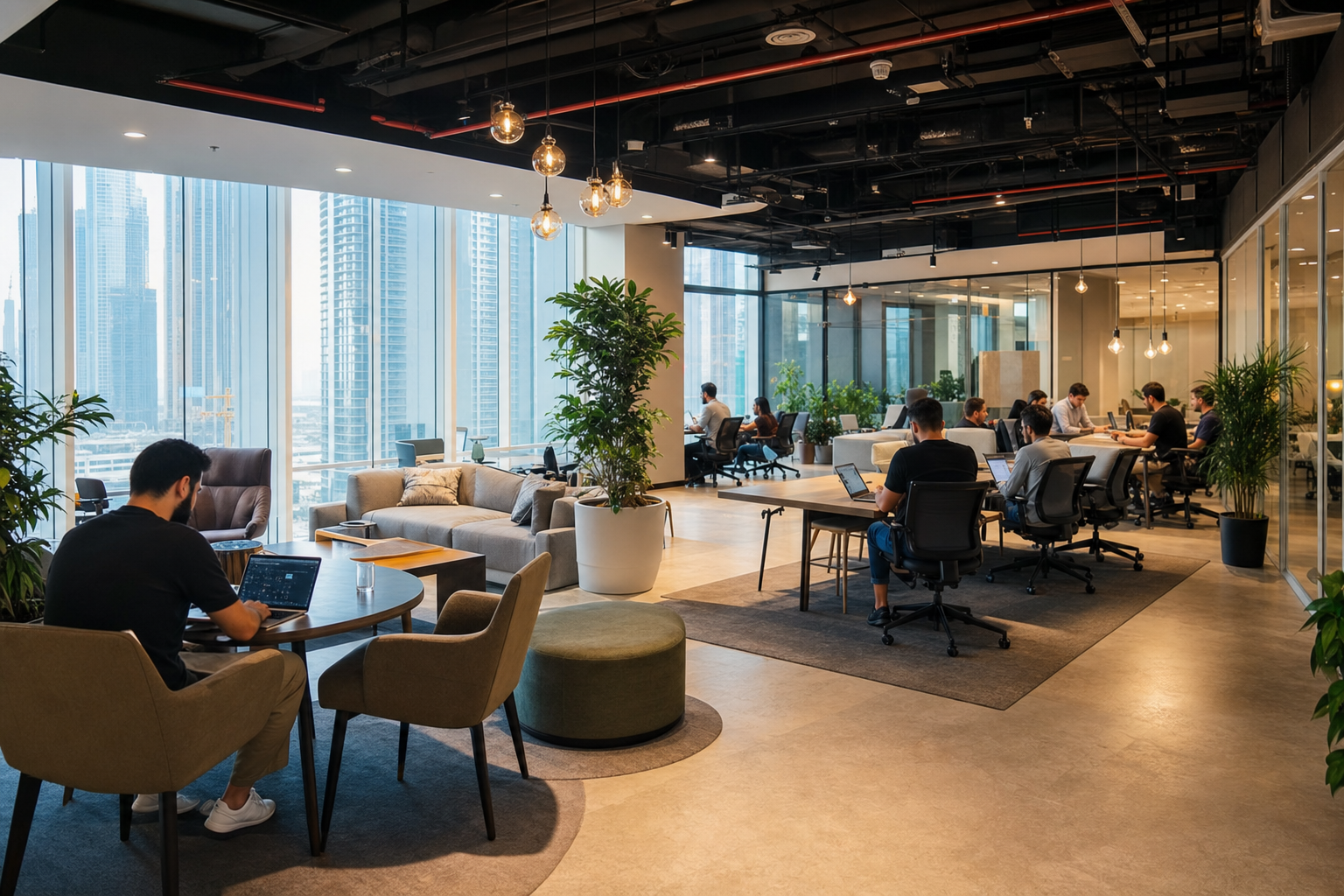
Searching for Regus Dubai Downtown usually means you need more than a desk. You need a credible address, reliable internet, a place to meet clients, and enough flexibility to avoid paying for space that sits unused. Downtown Dubai offers these conditions within a compact business district, but the right workspace depends on how often you work there and what your day requires.
Key Takeaways
Finding the right workspace in Downtown Dubai means evaluating what your workday actually demands beyond just a desk.
A credible business address paired with dependable infrastructure creates the continuity professionals need to stay productive anywhere.
Flexible arrangements should adapt to how often you actually use the space, not force you into paying for what sits empty.
The ideal workspace solution balances professional credibility with the freedom to move without losing your sense of base.
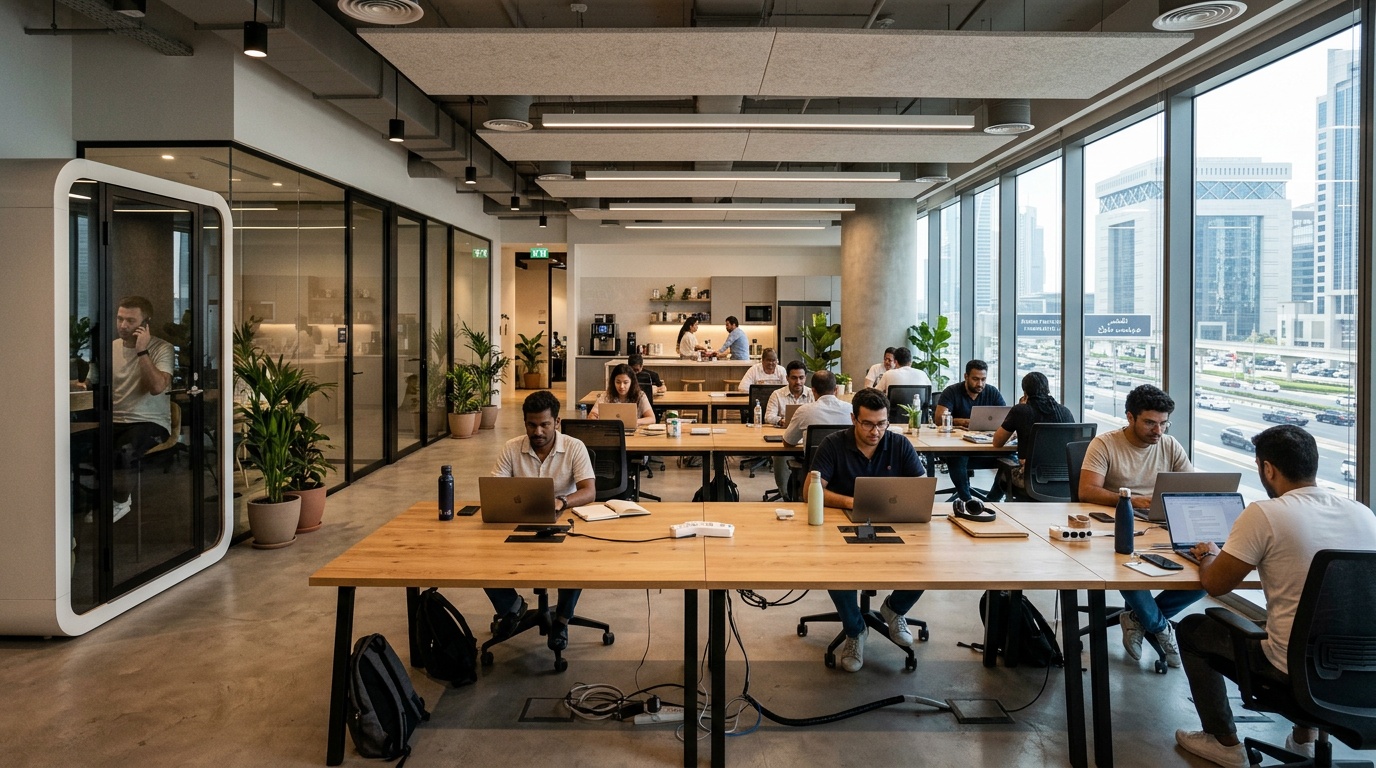
This guide covers the area around Boulevard Plaza and the Burj Khalifa, the main workspace formats, and the details to check before booking. For a flexible starting point, The Executive Centre Dubai provides an example of a workspace available through Hotdesk, without requiring every visitor to make a long-term commitment.
The Reality of Workspace Access in Downtown Dubai
Downtown Dubai suits professionals who value a central address, client-facing surroundings, and convenient access to hotels, retail, dining, and major transport links. A serviced office may include reception support, meeting rooms, and a private work environment. On-demand booking can be a better fit for consultants, traveling teams, remote employees, and businesses that need a desk or meeting room for a specific date.
What to Expect Near Boulevard Plaza and the Burj Khalifa
The area around Boulevard Plaza and the Burj Khalifa has a polished corporate character. High-rise towers, hotels, restaurants, retail destinations, and professional services sit within walking distance of one another. A client meeting, lunch appointment, and return to the workspace may all happen without a long drive across Dubai.
For people looking for corporate offices in Dubai, the district offers a recognizable address for visitors. The tradeoff is cost: central real estate reflects its location and surrounding infrastructure. A private office may suit a resident team, while a day office or meeting room can make more sense for a visiting executive or a business testing its presence in the city. Before booking, check the exact tower, reception process, access hours, parking arrangements, and included equipment. For a location-specific alternative, review Servcorp Boulevard Plaza.
The Shift From Long-Term Leases to On-Demand Infrastructure
Teams now move between projects, employees work from different cities, and founders may need a professional setting only for investor meetings or client visits. Fixed leases can be a poor fit in those situations. The cost may include deposits, furnishing, utilities, cleaning, internet service, access control, and unused capacity.
On-demand infrastructure separates the workplace from the long commitment. You can choose a hot desk for focused work, a private office for sensitive calls, or a meeting room for a defined period. That creates a more consistent working routine without requiring a permanent lease in every city. The Executive Centre Dubai is one featured option for users who want a premium setting while tying the booking to an actual work need.
Local booking check: Confirm the neighborhood, building access, room capacity, cancellation terms, and total amount before payment. A convenient location only helps if the workspace matches your schedule and working style.
Evaluating Workspace Options in Downtown Dubai
Assess a Downtown Dubai workspace by separating the format from the building experience. A day pass, private office, and meeting room solve different problems. Pricing changes with privacy, duration, room size, location, and included services, so published market ranges should be treated as benchmarks rather than guaranteed rates.
Types of Workspaces: Day Passes, Private Offices, and Meeting Rooms
A day pass suits independent work, short visits, and flexible schedules. It usually includes a desk, Wi-Fi, shared facilities, and access to a professional setting. A private office offers more privacy for confidential calls or concentrated team work. Meeting rooms are more specific: check seating capacity, display equipment, whiteboard access, video conferencing, visitor handling, and booking duration.
If you need a corporate address, ask whether the plan includes mail handling or receptionist support. If you only need somewhere to work between appointments, those services may add cost without adding value. Choose according to the work planned for that day, not the most elaborate package.
Amenities and Business Infrastructure at Standard Chartered Tower
A workspace in Standard Chartered Tower should be assessed as an operating environment, not only as a desk in a landmark building. Review internet quality, power access, seating, natural light, elevator access, security procedures, and reception support. For client meetings, clear directions, guest registration, and a room prepared on time can shape the arrival experience.
Ask about printing, coffee, phone booths, accessibility, parking, and after-hours entry before confirming a booking. These details often matter more than a long amenities list. Myoffice Downtown is another Dubai option to compare when flexibility and a central location matter.
Workspace format
Best suited for
Key details to confirm
Day coworking
Independent professionals and short visits
Desk type, Wi-Fi, access hours, shared-area rules
Private office
Small teams and confidential work
Occupancy, furnishings, privacy, minimum booking period
Meeting room
Client sessions, interviews, and team workshops
Capacity, screen, video calls, visitor access, cancellation terms
The Friction of Traditional Corporate Memberships
A search for a serviced office often starts with a clear need: a private room for a growing team or a meeting room near the Burj Khalifa. The difficulty begins when advertised flexibility turns into a sales process with limited pricing detail. A quote may require several calls before you know the monthly fee, deposit, access conditions, renewal date, or charges for mail handling and meeting rooms.
Opaque Pricing and Annual Price Hikes
A clear quote identifies the workspace type, billing period, taxes, included services, access hours, and optional charges. Before signing, request the renewal formula, notice period, payment schedule, and written confirmation that additional fees will be disclosed.
Difficult Cancellations and Rigid Contracts
A workspace that suits a six-person team may not fit the same company after a project ends. Read the cancellation clause as carefully as the rent. Check whether notice must be submitted through a specific channel, whether unused days receive credit, and whether renewal occurs automatically.
What to Check Before Signing
Pros
Predictable access can suit a resident team with a stable headcount.
A fixed office may support consistent storage, branding, and daily routines.
Reception, mail handling, and facilities support can reduce administrative work.
Cons
Quote-based pricing can make total occupancy costs difficult to assess.
Renewal increases may affect forecasts if the terms are not clearly stated.
Minimum commitments can leave businesses paying for unused desks or rooms.
A Transparent Alternative: On-Demand Booking in Downtown
On-demand booking changes the decision from “Which membership should I sign?” to “What space does this work require?” A consultant may need a quiet desk for one afternoon, while a distributed team may need a private room for a workshop. Hotdesk can connect those needs with available workspaces without making a long-term membership the starting point.
Instant Booking vs. Waiting for a Quote
Waiting for a quote adds friction before work has started. If instant booking is available for the selected listing, you can choose a date, workspace format, duration, and location, then review the terms before confirming. Booking around actual use keeps spending closer to real reservations.
How to Secure a Premium Address Without Membership Fees
A premium address does not always require a permanent lease. The right booking may provide a client-ready environment and access to facilities for the period that matters; confirm the specific services included in the listing.
Define the work: Decide whether you need a hot desk, private office, conference room, or presentation space.
Set the timing: Choose the exact date, number of hours, and expected attendee count.
Review the listing: Check building access, reception arrangements, internet, equipment, room capacity, and visitor procedures.
Confirm the total: Review the displayed price, cancellation terms, taxes, and included services before payment.
Book and arrive prepared: Save the confirmation, share access details with guests, and plan for building security or identification checks.
For anyone comparing workspace options in Downtown Dubai, a pay-as-you-go model offers a useful reference point. Flexibility means seeing the full cost, choosing the right duration, and avoiding an obligation that outlasts the business need.
Decision point
Traditional membership
On-demand booking through Hotdesk
Pricing visibility
May require a customized quote and sales discussion
Review the listed workspace and booking cost before confirmation
Commitment
Often structured around a recurring term or renewal
Select the date and duration that match the work planned
Best fit
Teams needing a consistent office setup
Traveling professionals, project teams, and occasional meetings
Cost control
Payment may continue during periods of low usage
Spend may be tied more closely to actual workspace reservations
Downtown Dubai vs. DMCC South (JLT): Choosing Your Base
Choosing between Downtown Dubai and DMCC South in Jumeirah Lake Towers depends on who needs to reach you, how often your team works in person, and whether the address supports client meetings, daily operations, or occasional visits. Downtown offers a central setting near the Burj Khalifa. DMCC South provides a practical JLT base near residential towers, public transit, restaurants, and parks.
Comparing Business Infrastructure and Prestige
Downtown favors visibility and proximity. DMCC South is suited to recurring collaboration and everyday business activity. Evaluate each location by commute, visitor access, meeting requirements, privacy, and total booking cost.
Which Location Suits Your Operational Needs?
Choose Downtown if your work depends on a recognizable central address, frequent meetings with senior clients, or access to hotels and premium services. Choose DMCC South if your team is based around JLT, Dubai Marina, or nearby residential communities, or if most work involves recurring collaboration rather than executive hosting.
Teams that move between districts may not need one fixed location. Review workspace options through Hotdesk and book according to each day’s meeting, commute, and privacy requirements. The address should support the work, not dictate it.
Neither provider is universally better because the right choice depends on your work pattern, budget, and how often you need a physical office. Both offer serviced offices and meeting rooms, but the differences emerge in location availability, contract flexibility, and building quality. In Downtown Dubai, compare the exact tower, reception process, and included amenities before committing to any brand name.
What is Regus called now?
Regus operates under its parent company IWG, though most locations still carry the Regus brand on signage and marketing. The IWG portfolio includes multiple workspace brands, so related names may appear on different buildings. When searching for Regus Dubai Downtown, verify whether the specific location matches your expectations for building quality and access hours.
What kind of office is Regus?
Regus provides serviced offices, coworking desks, and meeting rooms built for businesses that want professional infrastructure without a traditional long-term lease. The model separates the workspace from the commitment, so you can book a private office for confidential calls or a meeting room for a defined period. This suits visiting executives, remote teams, and founders who need credibility without fixed overhead.
Can we sleep in a coworking space?
No, coworking spaces are professional work environments with specific access hours and are not designed for sleeping. Day passes and hot desks serve focused work during business hours, not overnight stays. If you are working extended hours in Downtown Dubai, hotels within walking distance of Boulevard Plaza can bridge the gap between a late meeting and the next morning.
How much does a workspace in Downtown Dubai cost?
Workspace pricing in Downtown Dubai varies based on privacy level, duration, room size, and included services. A day pass generally costs less than a private office or meeting room because it prioritizes shared desk access. Treat published market rates as benchmarks, not guaranteed prices, and confirm the total amount plus cancellation terms before booking.
Do I need a long-term lease for office space in Downtown Dubai?
No, on-demand workspace lets you book a desk, private office, or meeting room without committing to a year-long lease. This flexibility works well for consultants, traveling teams, and businesses testing their presence in the city. You get continuity: a professional environment you can return to whenever needed, without paying for space that sits unused between visits.
What should I check before booking a workspace near Burj Khalifa?
Confirm the exact tower, reception process, access hours, parking arrangements, and whether the room includes the equipment your meeting requires. The arrival experience shapes the meeting before the first conversation begins, so clear directions, a professional lobby, and a room prepared on time all matter. A central location only helps if the workspace matches your schedule.
Mohamed Khaled is the Founder and CEO of Hotdesk, the on-demand workspace platform providing access to coworking spaces and flexible offices across more than 120 countries.
He spent nearly a decade at PwC before moving into financial leadership at SWVL, where he led the company’s $1.5 billion Nasdaq listing, the first Unicorn from thr Middle East to go public in the United States.
A Forbes 30 Under 30 honoree, Mohamed built Hotdesk from a side project into a global platform, leading a team of more than 50 and expanding into international markets, including the acquisition of Spain-based coworking marketplace YADO.
Also being Co-founder and President of DESK Token, the world’s first asset backed property investment and utility hybrid token, Mohammed is focused on building infrastructure that unlocks underutilized assets – from meeting rooms to private offices and full on buildings – while creating space for the future of work.
I'm a digital nomad visiting Hong Kong, which business center should I choose for short-term rentals?
I’m a digital nomad visiting Hong Kong, which business center should I choose for short-term rentals? Start with your daily route, not the office photos. Hong Kong Island, Kowloon, and the New Territories each support different work patterns, and the right choice is usually the center that keeps your commute predictable while providing dependable Wi-Fi, power, meeting space, and access control.
Key Takeaways
A desk near one MTR line may serve you better than a cheaper office that requires multiple transfers, a long walk, or repeated setup changes.
The same logic applies to booking flexibility: a short stay should not require a lease designed for a permanent company.
Hong Kong Island, Kowloon, and the New Territories each support different work patterns, and the right choice is usually the center that keeps your commute predictable while providing dependable Wi-Fi, power, meeting space, and access control.
Infrastructure travels with you only when the workspace fits your operating routine. A desk near one MTR line may serve you better than a cheaper office that requires multiple transfers, a long walk, or repeated setup changes. The same logic applies to booking flexibility: a short stay should not require a lease designed for a permanent company.
Hong Kong’s Infrastructure: Geography, Transit, and Workspace Basics
The Quick Answer: Choosing a Business Center by Region
If you are asking, “I’m a digital nomad visiting Hong Kong, which business center should I choose for short-term rentals?”, use a three-step filter. First, mark your accommodation and the locations of your meetings. Second, select a neighborhood reachable with no more than one practical transfer. Third, verify the workspace details: day access, desk type, phone booths, conference rooms, upload performance, backup connectivity, reception hours, and building entry rules.
Budget-conscious nomads report that HKD 16,000 can go “much, much further” in the New Territories than on Hong Kong Island, according to Goats on the Road. That saving has an operational cost if your work requires frequent Island meetings. Reports also indicate that travel from the New Territories to Hong Kong Island can lengthen a daily commute, so calculate time, transit fares, and fatigue together.
Hong Kong Island vs. Kowloon vs. New Territories
Hong Kong Island concentrates major commercial districts, including Central, Admiralty, and Wan Chai. It is a strong base for founders meeting investors, banks, agencies, or regional partners. The trade-off is a higher commercial rent environment and greater pressure on private office availability, especially for short stays.
Kowloon offers a useful middle position. Tsim Sha Tsui connects directly with Hong Kong Island by the Tsuen Wan line and Star Ferry, while Mong Kok provides dense retail, dining, residential, and transport access. The New Territories include more residential options and generally more space, with districts such as Tsuen Wan connected to central routes. That arrangement works best for remote-first schedules with limited face-to-face appointments.
Internet Infrastructure and MTR Transit Connectivity
Do not treat internet access as a decorative amenity. Ask whether the center provides dedicated business broadband, wired Ethernet, separate guest and private networks, stable video-call performance, sufficient electrical outlets, and a documented process for outages. A workspace operator should also explain how visitors authenticate, how long access takes, and whether meeting rooms have their own network capacity.
The MTR is the practical backbone of a Hong Kong work routine. The Island line serves the north side of Hong Kong Island, while the Tsuen Wan line links Kowloon with Central through cross-harbor service. Check the full route in Google Maps before booking, then confirm station exits and walking time. A location that appears close on a map may still require a steep street climb or a long passage through a major interchange.
Matching Business Centers to MTR Lines by Neighborhood
If you are still asking, “I’m a digital nomad visiting Hong Kong, which business center should I choose for short-term rentals?”, match the office to your dominant MTR line. This reduces transfer risk and protects your working hours. The best neighborhood is rarely the one with the most prestigious address. It is the one that keeps your morning route, client access, and return trip within a repeatable pattern.
Cross-harbor access, hospitality, international appointments
Visitor traffic and busy pedestrian routes
Mong Kok
Tsuen Wan line, Kwun Tong line, East Rail access
Retail, e-commerce, flexible daily work, central Kowloon
Compact streets and variable noise levels
Tsuen Wan
Tsuen Wan line
Longer stays, residential convenience, cost control
Longer journeys for frequent Island meetings
Hong Kong Island: Central and Wan Chai Workspace Profiles
Central suits a schedule built around client calls, investor meetings, financial institutions, and formal presentations. Wan Chai can be more practical for a mixed routine because the Island line provides direct east-west movement, and the district combines offices, restaurants, hotels, and residential buildings. Prioritize a center within a short walk of the station, since heat, rain, and steep streets affect the real commute.
For a short-term rental, inspect meeting-room booking rules and visitor reception before choosing a desk. A polished lobby does not guarantee quiet calls, reliable printing, or after-hours access. Operators should provide clear information about desk availability, lockers, phone booths, and cancellation terms.
Kowloon: Tsim Sha Tsui and Mong Kok Accessibility
Tsim Sha Tsui is useful when your week includes both sides of Victoria Harbour. The Tsuen Wan line provides a direct rail connection toward Central, and nearby ferry services add another transport option. Mong Kok is better suited to founders who value street-level convenience, local suppliers, retail activity, food access, and several MTR route choices.
Ask for the exact station entrance, floor number, elevator access, and sound conditions around the office. In dense districts, a five-minute route can change significantly during peak pedestrian periods. If you need a business address for meetings, confirm the visitor policy before payment.
New Territories: Tsuen Wan and Cost-Effective Alternatives
Tsuen Wan works for remote professionals who need a stable base more than a central address. The Tsuen Wan line offers a direct route toward Kowloon and Hong Kong Island, while nearby residential services can reduce daily errands. This can support focused writing, software development, design, and asynchronous e-commerce work.
The calculation changes if you cross the harbor every day. A lower rental cost may be offset by extra transit time, transfer exposure, and reduced energy for client work. If the New Territories fits your accommodation, book a trial day first, test the network during your real work hours, and measure the complete door-to-desk route.
For travelers who later work from Dubai, Ascendris Business Bay provides an example of a named workspace listing. The same evaluation habit applies in Hong Kong: verify location, access, desk format, and booking conditions before committing. Details about the listing should be confirmed on its current page before publication.
I’m a digital nomad visiting Hong Kong, which business center should I choose for short-term rentals? Select the neighborhood that minimizes repeated friction: one practical rail route, dependable connectivity, suitable meeting access, and a booking period that matches your stay.
Transparent Pricing for Day Passes and Weekly Office Rentals
Short-term workspace pricing in Hong Kong depends on location, privacy, access hours, and the services included with the desk. Central and Causeway Bay generally carry higher commercial costs, while Kowloon and the New Territories can offer more measured operating expenses. A lower rate only helps if the location also protects your time, connectivity, and ability to meet clients.
Ask for the complete price before booking. The total may include taxes, meeting-room credits, printing, mail handling, security deposits, weekend access, or charges for additional visitors. A clear listing should state whether the booking covers a shared desk, dedicated workstation, private office, reception support, Wi-Fi, power, and access during your intended hours.
How Much Short-Term Workspace Actually Costs in Hong Kong
Expect a day pass to cost more per working day than a weekly booking because the operator carries higher turnover and access-management costs. A hot desk usually provides a shared seating area, while a private office adds lockable space, greater privacy, and more predictable control over calls or sensitive work. Exact rates vary by building and availability, so use the following as a comparison framework rather than a quoted tariff.
Workspace format
Best for
Price structure to verify
Operational questions
Day pass
One-off workday or short visit
Daily rate, tax, access hours
Is seating guaranteed, and are calls permitted?
Hot desk
Flexible work across several days
Daily or weekly bundle, booking limits
Can you reserve a desk, locker, or monitor?
Private office
Confidential calls or focused project work
Daily, weekly, or monthly rate, deposit
Are furniture, utilities, cleaning, and meeting access included?
Comparing Day Passes, Hot Desks, and Private Offices
Choose a day pass when your itinerary is uncertain or you need a workspace near a specific meeting. A weekly hot desk is more suitable when your schedule has repeated work blocks but does not justify a fixed office. A private office makes sense when your work involves confidential documents, frequent video conferences, a small project team, or equipment that should remain in place.
Calculate the effective cost per productive day, not only the advertised rental price. Include transportation, meals during a long commute, meeting-room fees, and time lost through transfers. A cheaper center in Tsuen Wan may be financially sensible for asynchronous work, while a higher-priced Kowloon location may produce better total value if it prevents repeated cross-harbor travel.
Avoiding Long-Term Lease Commitments in High-Cost Districts
Traditional office agreements can require deposits, minimum terms, furnishing decisions, utility setup, and administrative work that exceed a nomad’s actual stay. Avoid committing before testing the building, network performance, noise level, access control, and meeting facilities during normal working hours.
Short-term access preserves optionality. You can work near a client for one day, move closer to your accommodation for a focused week, or change districts when your meeting schedule changes. The right system treats workspace as an operating input that can move with your schedule, rather than a permanent real estate decision.
Bypassing Rigid Leases With On-Demand Workspace Systems
How can a visiting professional access a business center without signing a corporate lease? Compare available workspace options, booking conditions, access instructions, and operator details before choosing a day, week, or month.
How Instant Booking Platforms Operate
Before using any platform, verify whether membership is required and review the current booking terms. Search and listing information may include city, neighborhood, workspace type, date, duration, photographs, desk capacity, opening hours, address, amenities, cancellation policy, and building-entry instructions; confirm each detail before payment.
Before using Hotdesk, verify its current booking terms, availability, payment status, and access instructions. Ascendris Business Bay is an example of a named Hotdesk listing. Its current workspace details and booking path should be confirmed on the linked page before publication. A specific listing is more useful for evaluation than a generic promise of office access.
Workspace Operator Reliability
At Hotdesk, confirm how booking data, availability, payment status, and access instructions are handled for the specific workspace and booking. Infrastructure supports the user only when those records are accurate from search through arrival.
From an infrastructure perspective, reliability means reducing re-work. A traveler should not need to repeat the same request across email threads, wait for manual confirmation, or discover that the listed desk is unavailable after payment. Operator workflows still matter: reception procedures, access credentials, room readiness, internet support, and escalation paths determine whether the digital booking matches the physical workspace.
Steps to Secure a Flexible Workspace for a Day or Month
Use this sequence before confirming any short-term office:
Set the booking window around your actual workdays, not your entire trip.
Filter for the required format, such as a hot desk, dedicated desk, or private office.
Check the route, station exit, building entry process, and walking time.
Review the full price, cancellation conditions, and access hours.
Save the booking confirmation and arrival instructions offline.
For a single day, prioritize verified access and a short route. For a month, test the center first or choose a booking that preserves the ability to change location. A repeatable process is preferable to a longer contract. It keeps workspace, payment, and access aligned with the user’s changing schedule.
Visa Rules and Cross-Border Technical Operations
A business center solves only one part of a Hong Kong workday. Before booking a desk, confirm your right to enter and conduct permitted activities, then prepare the software, payments, and network access your business depends upon. Immigration status and technical continuity should be checked together, especially if your trip includes mainland China.
Visa Pathways and Tax Rules for Remote Workers
Many visitors enter Hong Kong under a visa-exempt arrangement or visitor permission, depending on nationality and passport conditions. The permitted period and activities vary, so check the Hong Kong Immigration Department before departure. A visitor status should not be treated as a general work authorization, particularly if you will serve local clients, receive employment income from a Hong Kong entity, or operate a locally established business.
Tax treatment depends on the source of income, where services are performed, contract structure, and the facts connected with a jurisdiction. Do not rely on a general claim that offshore income is taxed at 0%; check current official Hong Kong Inland Revenue Department guidance. Consult a qualified tax professional for your circumstances, and keep invoices, contracts, travel dates, business registration records, and payment documentation.
Managing Digital Infrastructure: Hong Kong vs. Mainland China
Hong Kong and mainland China should be treated as separate operating environments. Verify whether a Hong Kong business center supports the services your team uses globally, including Google Workspace, Google Maps, Slack, GitHub, cloud dashboards, and international payment tools. Access patterns can differ after crossing the boundary, and a mainland connection may require approved business tools, local accounts, or a company-managed network configuration.
Do not assume that a Hong Kong SIM, eSIM, VPN, or cloud login will provide the same behavior in Shenzhen or another mainland destination. Test authentication before travel, confirm multifactor authentication methods, store recovery codes securely, and ask your employer or hosting provider about regional access policies. Alipay can be useful for local payments, while Google Maps remains practical for Hong Kong route planning. Keep an offline address, station name, and meeting contact available if mobile data becomes unreliable.
Software and Network Preparation for E-Commerce Founders
E-commerce operators should map every dependency before arrival: storefront administration, payment gateway, advertising account, inventory system, customer support inbox, warehouse portal, analytics dashboard, and supplier communications. Record which services require a specific country setting, trusted device, phone number, or security key. This prevents a login challenge from stopping order management during a short booking.
At the workspace, ask whether the network uses a shared guest connection or a private VLAN, which separates traffic logically. Use HTTPS, a password manager, hardware-based multifactor authentication where available, and a company-approved VPN. Avoid handling payment credentials on unknown computers, and confirm upload performance before scheduling large product media transfers or live customer-support sessions.
Ascendris Business Bay illustrates a useful booking principle: a named workspace should be evaluated through its location, access details, desk format, and stated amenities. It is not a Hong Kong visa solution, and the same operational checklist applies when selecting temporary workspace in any country.
The practical verdict is straightforward: verify immigration permission first, separate Hong Kong and mainland connectivity assumptions, and test your business software before the first workday. Infrastructure travels with the user only when legal status, network access, identity controls, and workspace procedures have been checked as one system.
Mohammad El Shaari is the CTO of Hotdesk, where he leads the engineering team building and scaling a global SaaS platform for on-demand workspace bookings across 80+ countries. A Computer Science graduate from The British University in Egypt, he brings over a decade of hands-on experience in enterprise software, AI, cloud infrastructure, and cybersecurity.
Before Hotdesk, he served as CTO of Vee Tech, where he led technical delivery for 12+ enterprise clients generating $30M+ in annual revenue, and helped build Egypt’s first innovation lab at Capital International Schools.
At Hotdesk, Mohammad focuses on building scalable systems that handle real-time availability, global user distribution, and high-throughput transactions. He specializes in scalable system design, cloud-native infrastructure, and building high-performance SaaS platforms that support global user bases.
He writes about scaling SaaS platforms, backend architecture, mobile engineering, and real-world technical decisions behind building and operating global products.
Best coworking spaces in Dubai for international remote workers
The best coworking space in Dubai depends on your daily location, working hours, call schedule, and length of stay. International remote workers usually need dependable internet, quiet places for calls, practical access hours, and a commute they can manage. A day pass often reveals more than polished photographs.
Key Takeaways
The best coworking space in Dubai depends on your daily location, working hours, call schedule, and length of stay.
International remote workers usually need dependable internet, quiet places for calls, practical access hours, and a commute they can manage.
A day pass often reveals more than polished photographs.
What are the best coworking spaces in Dubai for international remote workers?
The strongest options combine dependable connectivity, suitable call facilities, clear pricing, convenient transport, and access hours that match your workday. The right choice depends on your routine: a consultant may need a meeting room near a client, while a freelancer may value a quiet desk near home.
Downtown suits central meetings and nearby dining. Dubai Internet City and Barsha Heights work well for people near technology companies and startups, while Dubai Marina may be more practical for workers staying in that part of the city. Distance matters more than a striking lobby once the working week begins.
Benefits of coworking spaces for international remote workers
A coworking space gives an international professional a working base without the paperwork or fixed cost of a conventional office lease. You can reserve a desk for a short visit, choose weekly access for a project, or move to a dedicated desk if your stay becomes longer.
Check the details that affect an ordinary workday: internet reliability, backup connectivity, power outlets, seating, phone booths, meeting rooms, and entry hours. Returning to one familiar place can also reduce the daily friction of working in an unfamiliar city. Small consistencies add up.
How to choose the best coworking space in Dubai
Choose based on your actual schedule rather than the venue’s appearance. Consider where you will stay, how often you take calls, how long you will work in Dubai, and when your clients are online. A day pass lets you test the neighbourhood, noise levels, internet performance, and reception before arranging recurring access.
Daytime, evening, weekend, or extended-hours entry
Global clients may work across several time zones
Connectivity
Wi-Fi speed, backup internet, power, and call quality
Weak connections disrupt meetings
Booking flexibility
Daily passes, weekly access, monthly plans, and cancellation terms
Short stays do not require a long lease
Work environment
Quiet zones, phone booths, ergonomic seating, and natural light
Different tasks require different privacy levels
The best workspace is the one that removes repeated decisions from your day. If you can arrive, find a suitable seat, take calls, and leave without friction, the space is doing its job.
Frequently Asked Questions
What should international remote workers look for?
Prioritise dependable internet, accessible power, suitable seating, private areas for calls, transparent pricing, and hours that match your clients’ time zones.
How much does coworking cost in Dubai?
Prices vary by venue, district, access schedule, amenities, and privacy. Calculate the full expense rather than comparing the desk fee alone.
Which Dubai areas suit digital nomads?
Downtown, Business Bay, Dubai Internet City, Barsha Heights, and Dubai Marina each suit different commuting and lifestyle needs.
Mohamed Khaled is the Founder and CEO of Hotdesk, the on-demand workspace platform providing access to coworking spaces and flexible offices across more than 120 countries.
He spent nearly a decade at PwC before moving into financial leadership at SWVL, where he led the company’s $1.5 billion Nasdaq listing, the first Unicorn from thr Middle East to go public in the United States.
A Forbes 30 Under 30 honoree, Mohamed built Hotdesk from a side project into a global platform, leading a team of more than 50 and expanding into international markets, including the acquisition of Spain-based coworking marketplace YADO.
Also being Co-founder and President of DESK Token, the world’s first asset backed property investment and utility hybrid token, Mohammed is focused on building infrastructure that unlocks underutilized assets – from meeting rooms to private offices and full on buildings – while creating space for the future of work.
Mohamed Khaled is the Founder and CEO of Hotdesk, the on-demand workspace platform providing access to coworking spaces and flexible offices across more than 120 countries.
He spent nearly a decade at PwC before moving into financial leadership at SWVL, where he led the company’s $1.5 billion Nasdaq listing, the first Unicorn from thr Middle East to go public in the United States.
A Forbes 30 Under 30 honoree, Mohamed built Hotdesk from a side project into a global platform, leading a team of more than 50 and expanding into international markets, including the acquisition of Spain-based coworking marketplace YADO.
Also being Co-founder and President of DESK Token, the world’s first asset backed property investment and utility hybrid token, Mohammed is focused on building infrastructure that unlocks underutilized assets – from meeting rooms to private offices and full on buildings – while creating space for the future of work.
Mohamed Khaled is the Founder and CEO of Hotdesk, the on-demand workspace platform providing access to coworking spaces and flexible offices across more than 120 countries.
He spent nearly a decade at PwC before moving into financial leadership at SWVL, where he led the company’s $1.5 billion Nasdaq listing, the first Unicorn from thr Middle East to go public in the United States.
A Forbes 30 Under 30 honoree, Mohamed built Hotdesk from a side project into a global platform, leading a team of more than 50 and expanding into international markets, including the acquisition of Spain-based coworking marketplace YADO.
Also being Co-founder and President of DESK Token, the world’s first asset backed property investment and utility hybrid token, Mohammed is focused on building infrastructure that unlocks underutilized assets – from meeting rooms to private offices and full on buildings – while creating space for the future of work.
Mohamed Khaled is the Founder and CEO of Hotdesk, the on-demand workspace platform providing access to coworking spaces and flexible offices across more than 120 countries.
He spent nearly a decade at PwC before moving into financial leadership at SWVL, where he led the company’s $1.5 billion Nasdaq listing, the first Unicorn from thr Middle East to go public in the United States.
A Forbes 30 Under 30 honoree, Mohamed built Hotdesk from a side project into a global platform, leading a team of more than 50 and expanding into international markets, including the acquisition of Spain-based coworking marketplace YADO.
Also being Co-founder and President of DESK Token, the world’s first asset backed property investment and utility hybrid token, Mohammed is focused on building infrastructure that unlocks underutilized assets – from meeting rooms to private offices and full on buildings – while creating space for the future of work.
Mohamed Khaled is the Founder and CEO of Hotdesk, the on-demand workspace platform providing access to coworking spaces and flexible offices across more than 120 countries.
He spent nearly a decade at PwC before moving into financial leadership at SWVL, where he led the company’s $1.5 billion Nasdaq listing, the first Unicorn from thr Middle East to go public in the United States.
A Forbes 30 Under 30 honoree, Mohamed built Hotdesk from a side project into a global platform, leading a team of more than 50 and expanding into international markets, including the acquisition of Spain-based coworking marketplace YADO.
Also being Co-founder and President of DESK Token, the world’s first asset backed property investment and utility hybrid token, Mohammed is focused on building infrastructure that unlocks underutilized assets – from meeting rooms to private offices and full on buildings – while creating space for the future of work.
Mohamed Khaled is the Founder and CEO of Hotdesk, the on-demand workspace platform providing access to coworking spaces and flexible offices across more than 120 countries.
He spent nearly a decade at PwC before moving into financial leadership at SWVL, where he led the company’s $1.5 billion Nasdaq listing, the first Unicorn from thr Middle East to go public in the United States.
A Forbes 30 Under 30 honoree, Mohamed built Hotdesk from a side project into a global platform, leading a team of more than 50 and expanding into international markets, including the acquisition of Spain-based coworking marketplace YADO.
Also being Co-founder and President of DESK Token, the world’s first asset backed property investment and utility hybrid token, Mohammed is focused on building infrastructure that unlocks underutilized assets – from meeting rooms to private offices and full on buildings – while creating space for the future of work.
Work may take you from home to an office, across cities, or between client sites. Water is one of the few steady parts of the day, yet meetings and travel can make it easy to forget. Hydration tracking apps turn that routine into something visible and easier to maintain.
Key Takeaways
Work may take you from home to an office , across cities, or between client sites.
Water is one of the few steady parts of the day, yet meetings and travel can make it easy to forget.
Hydration tracking apps turn that routine into something visible and easier to maintain.
A full day of calls can pass before you notice how little you have had to drink. An app can prompt you to pause, record a glass or bottle, and return to work. That can be useful in a flexible office space or a coworking workspace, where your surroundings and schedule may change.
Why Hydration Matters for Focus and Consistency
Even mild dehydration may affect some aspects of cognitive performance and mood in controlled settings. Individual needs differ, though, so an app cannot promise sharper concentration or determine the right intake for everyone. Its practical role is narrower: it helps you notice a habit that might otherwise disappear during a demanding workday.
How Hydration Tracking Apps Build Reliable Habits
Most hydration tracking apps combine drink logging, reminders, daily targets, and progress views. Together, these features move the task from memory to a simple routine. The best reminder is the one you can follow, such as a prompt between meetings rather than one that interrupts a presentation.
The routine can also travel with you. A bottle logged in a Barcelona workspace is still part of the same habit when your next workday begins elsewhere.
What to Look for in a Hydration Tracking App
Flexible reminders: Adjust timing, frequency, and quiet hours to fit your working day.
Simple logging: Record common bottle or glass sizes in a few taps.
Useful personalisation: Account for activity, climate, and advice from a qualified professional.
Clear progress: Review patterns without treating a default target as medical guidance.
Privacy controls: Check what health information the app stores and shares.
Where App Guidance Has Limits
Hydration apps are habit tools, not diagnostic tools. People with kidney, heart, or other medical conditions should follow advice from a qualified healthcare professional instead of relying on an app’s default target.
A Hydration Routine for a Changing Workday
A workable routine needs to fit the parts of your day that stay predictable. Try these steps:
Carry a reusable bottle and identify a nearby refill point.
Fill the bottle before settling into work.
Set reminders during natural pauses, such as between meetings.
Log drinks using the closest bottle or glass size.
Review the pattern the next day and adjust the reminders.
The importance of hydration tracking apps is practical, not dramatic. They make water intake visible and offer prompts that can hold a routine together when the workday keeps moving. If your needs differ because of a health condition, use guidance from a qualified healthcare professional rather than an app alone.
Mohamed Khaled is the Founder and CEO of Hotdesk, the on-demand workspace platform providing access to coworking spaces and flexible offices across more than 120 countries.
He spent nearly a decade at PwC before moving into financial leadership at SWVL, where he led the company’s $1.5 billion Nasdaq listing, the first Unicorn from thr Middle East to go public in the United States.
A Forbes 30 Under 30 honoree, Mohamed built Hotdesk from a side project into a global platform, leading a team of more than 50 and expanding into international markets, including the acquisition of Spain-based coworking marketplace YADO.
Also being Co-founder and President of DESK Token, the world’s first asset backed property investment and utility hybrid token, Mohammed is focused on building infrastructure that unlocks underutilized assets – from meeting rooms to private offices and full on buildings – while creating space for the future of work.
Mohamed Khaled is the Founder and CEO of Hotdesk, the on-demand workspace platform providing access to coworking spaces and flexible offices across more than 120 countries.
He spent nearly a decade at PwC before moving into financial leadership at SWVL, where he led the company’s $1.5 billion Nasdaq listing, the first Unicorn from thr Middle East to go public in the United States.
A Forbes 30 Under 30 honoree, Mohamed built Hotdesk from a side project into a global platform, leading a team of more than 50 and expanding into international markets, including the acquisition of Spain-based coworking marketplace YADO.
Also being Co-founder and President of DESK Token, the world’s first asset backed property investment and utility hybrid token, Mohammed is focused on building infrastructure that unlocks underutilized assets – from meeting rooms to private offices and full on buildings – while creating space for the future of work.
Mohamed Khaled is the Founder and CEO of Hotdesk, the on-demand workspace platform providing access to coworking spaces and flexible offices across more than 120 countries.
He spent nearly a decade at PwC before moving into financial leadership at SWVL, where he led the company’s $1.5 billion Nasdaq listing, the first Unicorn from thr Middle East to go public in the United States.
A Forbes 30 Under 30 honoree, Mohamed built Hotdesk from a side project into a global platform, leading a team of more than 50 and expanding into international markets, including the acquisition of Spain-based coworking marketplace YADO.
Also being Co-founder and President of DESK Token, the world’s first asset backed property investment and utility hybrid token, Mohammed is focused on building infrastructure that unlocks underutilized assets – from meeting rooms to private offices and full on buildings – while creating space for the future of work.
Mohamed Khaled is the Founder and CEO of Hotdesk, the on-demand workspace platform providing access to coworking spaces and flexible offices across more than 120 countries.
He spent nearly a decade at PwC before moving into financial leadership at SWVL, where he led the company’s $1.5 billion Nasdaq listing, the first Unicorn from thr Middle East to go public in the United States.
A Forbes 30 Under 30 honoree, Mohamed built Hotdesk from a side project into a global platform, leading a team of more than 50 and expanding into international markets, including the acquisition of Spain-based coworking marketplace YADO.
Also being Co-founder and President of DESK Token, the world’s first asset backed property investment and utility hybrid token, Mohammed is focused on building infrastructure that unlocks underutilized assets – from meeting rooms to private offices and full on buildings – while creating space for the future of work.
Mohamed Khaled is the Founder and CEO of Hotdesk, the on-demand workspace platform providing access to coworking spaces and flexible offices across more than 120 countries.
He spent nearly a decade at PwC before moving into financial leadership at SWVL, where he led the company’s $1.5 billion Nasdaq listing, the first Unicorn from thr Middle East to go public in the United States.
A Forbes 30 Under 30 honoree, Mohamed built Hotdesk from a side project into a global platform, leading a team of more than 50 and expanding into international markets, including the acquisition of Spain-based coworking marketplace YADO.
Also being Co-founder and President of DESK Token, the world’s first asset backed property investment and utility hybrid token, Mohammed is focused on building infrastructure that unlocks underutilized assets – from meeting rooms to private offices and full on buildings – while creating space for the future of work.
Are London Blackfriars coworking spaces considered a good investment for businesses by industry analysts?
Blackfriars coworking spaces can be a sound business investment when occupancy, pricing, lease terms, and property costs support the model. Industry analysts cannot apply one return figure to every site: the result depends on the building, customer mix, contract structure, and operating discipline.
Key Takeaways
Blackfriars coworking spaces can be a sound business investment when occupancy, pricing, lease terms, and property costs support the model.
Industry analysts cannot apply one return figure to every site: the result depends on the building, customer mix, contract structure, and operating discipline.
A flexible workspace can reduce fit-out and long-lease commitments, while a dedicated office may become more economical for a stable team with predictable demand.
What does this assessment say about Blackfriars coworking investment?
Blackfriars may support workspace demand because it sits near financial services, transport links, cultural venues, and established commercial districts. Those factors can help attract teams, visitors, and clients, but they do not establish a return on investment.
For a business comparing a conventional lease with a Blackfriars flexible workspace, the useful comparison is total cost against actual usage. A flexible workspace can reduce fit-out and long-lease commitments, while a dedicated office may become more economical for a stable team with predictable demand.
Asking prices are not net margin. Revenue from a private office workspace must be assessed alongside rent, business rates, fit-out, staffing, cleaning, utilities, insurance, software, maintenance, sales commissions, and vacant capacity.
Why might Blackfriars coworking spaces appeal to businesses?
Blackfriars coworking spaces may suit businesses that need a central base without committing to a full office fit-out. Teams can book desks, meeting rooms, or private offices as their headcount and workload change. The financial case is strongest when this flexibility matches real usage rather than replacing a consistently occupied dedicated office.
Location can also affect client access and commuting time. Yet each product has a different utilisation pattern: meeting rooms may sell in concentrated periods, desks may depend on daily demand, and private offices often rely on longer contracts. Forecasting them as one revenue stream can hide weak performance.
How should a business assess a Blackfriars coworking investment?
Start with a property-level forecast, not the prestige of the address. Separate each revenue stream, list recurring and variable costs, calculate break-even occupancy, and test what happens if bookings fall or operating expenses rise.
Forecast revenue by product. Estimate demand, price, and booking frequency separately for desks, meeting rooms, private offices, memberships, and events.
List every property cost. Include rent, service charges, business rates, insurance, furniture, utilities, cleaning, staffing, security, software, repairs, marketing, payment processing, and vacancy.
Calculate break-even occupancy. Identify the utilisation level required to cover fixed costs, then compare it with a realistic demand forecast.
Review the lease. Check break clauses, rent reviews, repair obligations, permitted use, reinstatement costs, assignment rights, and landlord consent requirements.
Test downside cases. Model lower occupancy, cancellations, higher utility costs, delayed sales, and shorter customer contracts.
Businesses can compare flexible workspace models and services through options such as premium London business workspace before committing to a location. The right choice is the model that remains workable under conservative assumptions, not only the one with the most visible address.
References
London Plan 2021
Frequently Asked Questions
What does this article say about investing in Blackfriars coworking spaces?
This article does not establish a Blackfriars-wide return on investment. Investors should verify occupancy, average contract value, operating expenses, lease terms, and cash flow for the specific site.
Mohammad El Shaari is the CTO of Hotdesk, where he leads the engineering team building and scaling a global SaaS platform for on-demand workspace bookings across 80+ countries. A Computer Science graduate from The British University in Egypt, he brings over a decade of hands-on experience in enterprise software, AI, cloud infrastructure, and cybersecurity.
Before Hotdesk, he served as CTO of Vee Tech, where he led technical delivery for 12+ enterprise clients generating $30M+ in annual revenue, and helped build Egypt’s first innovation lab at Capital International Schools.
At Hotdesk, Mohammad focuses on building scalable systems that handle real-time availability, global user distribution, and high-throughput transactions. He specializes in scalable system design, cloud-native infrastructure, and building high-performance SaaS platforms that support global user bases.
He writes about scaling SaaS platforms, backend architecture, mobile engineering, and real-world technical decisions behind building and operating global products.
Mohammad El Shaari is the CTO of Hotdesk, where he leads the engineering team building and scaling a global SaaS platform for on-demand workspace bookings across 80+ countries. A Computer Science graduate from The British University in Egypt, he brings over a decade of hands-on experience in enterprise software, AI, cloud infrastructure, and cybersecurity.
Before Hotdesk, he served as CTO of Vee Tech, where he led technical delivery for 12+ enterprise clients generating $30M+ in annual revenue, and helped build Egypt’s first innovation lab at Capital International Schools.
At Hotdesk, Mohammad focuses on building scalable systems that handle real-time availability, global user distribution, and high-throughput transactions. He specializes in scalable system design, cloud-native infrastructure, and building high-performance SaaS platforms that support global user bases.
He writes about scaling SaaS platforms, backend architecture, mobile engineering, and real-world technical decisions behind building and operating global products.
Mohammad El Shaari is the CTO of Hotdesk, where he leads the engineering team building and scaling a global SaaS platform for on-demand workspace bookings across 80+ countries. A Computer Science graduate from The British University in Egypt, he brings over a decade of hands-on experience in enterprise software, AI, cloud infrastructure, and cybersecurity.
Before Hotdesk, he served as CTO of Vee Tech, where he led technical delivery for 12+ enterprise clients generating $30M+ in annual revenue, and helped build Egypt’s first innovation lab at Capital International Schools.
At Hotdesk, Mohammad focuses on building scalable systems that handle real-time availability, global user distribution, and high-throughput transactions. He specializes in scalable system design, cloud-native infrastructure, and building high-performance SaaS platforms that support global user bases.
He writes about scaling SaaS platforms, backend architecture, mobile engineering, and real-world technical decisions behind building and operating global products.
Mohammad El Shaari is the CTO of Hotdesk, where he leads the engineering team building and scaling a global SaaS platform for on-demand workspace bookings across 80+ countries. A Computer Science graduate from The British University in Egypt, he brings over a decade of hands-on experience in enterprise software, AI, cloud infrastructure, and cybersecurity.
Before Hotdesk, he served as CTO of Vee Tech, where he led technical delivery for 12+ enterprise clients generating $30M+ in annual revenue, and helped build Egypt’s first innovation lab at Capital International Schools.
At Hotdesk, Mohammad focuses on building scalable systems that handle real-time availability, global user distribution, and high-throughput transactions. He specializes in scalable system design, cloud-native infrastructure, and building high-performance SaaS platforms that support global user bases.
He writes about scaling SaaS platforms, backend architecture, mobile engineering, and real-world technical decisions behind building and operating global products.
Mohammad El Shaari is the CTO of Hotdesk, where he leads the engineering team building and scaling a global SaaS platform for on-demand workspace bookings across 80+ countries. A Computer Science graduate from The British University in Egypt, he brings over a decade of hands-on experience in enterprise software, AI, cloud infrastructure, and cybersecurity.
Before Hotdesk, he served as CTO of Vee Tech, where he led technical delivery for 12+ enterprise clients generating $30M+ in annual revenue, and helped build Egypt’s first innovation lab at Capital International Schools.
At Hotdesk, Mohammad focuses on building scalable systems that handle real-time availability, global user distribution, and high-throughput transactions. He specializes in scalable system design, cloud-native infrastructure, and building high-performance SaaS platforms that support global user bases.
He writes about scaling SaaS platforms, backend architecture, mobile engineering, and real-world technical decisions behind building and operating global products.
Every distributed system asks you to manage new failure modes. For a growing company, the office is part of that system: location, access, connectivity, meeting capacity, legal address, and monthly cost all affect how work gets done. This guide outlines Dubai workspace models and the checks to complete before booking.
Key Takeaways
Every distributed system asks you to manage new failure modes.
For a growing company, the office is part of that system: location, access, connectivity, meeting capacity, legal address, and monthly cost all affect how work gets done.
This guide outlines Dubai workspace models and the checks to complete before booking.
Corporate offices in Dubai are professional workspaces that give companies a structured place to work without requiring an immediate long-term lease. They can include private offices, dedicated desks, hot desks, meeting rooms, reception services, business lounges, internet, printing, kitchens, and administrative support. The Executive Centre Dubai is one listing to evaluate.
A serviced office is furnished and managed for you. Coworking provides shared seating and facilities, while a day office offers private space for a defined period. A virtual office may provide a business address or mail handling without daily desk access.
District choice affects daily operations. DMCC is a free-zone business district, while JLT contains commercial towers with flexible workspace options. Companies comparing providers, including searches for Regus Dubai DMCC South, should verify the exact building, visitor process, access hours, and included services rather than relying on the provider name alone.
What are the benefits of corporate offices in Dubai?
The main benefit is operational flexibility: a company can match workspace capacity to actual attendance and changing headcount. Furniture, internet, reception coverage, shared facilities, and meeting rooms can be available without requiring the company to build and run a separate office operation.
This arrangement also limits commitment while a team tests a location or hiring plan. A company might start with one desk, add seats during a project, or reserve a private room for client meetings. For teams considering JLT, flexible workspace in Jumeirah Lake Towers is one option to compare.
How should you choose a corporate office in Dubai?
Choose a Business Bay workspace by documenting the work your team must complete there. Then compare capacity, access, services, and total cost against those requirements. A low headline price is not useful if meeting rooms, deposits, or access restrictions create extra costs later.
Define the workspace type. A hot desk suits irregular attendance. A dedicated desk gives one person a consistent workstation. A private office offers greater privacy and team control.
Check the location. Review transport, parking, visitor access, and nearby services.
Verify operating details. Confirm internet, access hours, meeting-room availability, reception coverage, cleaning, storage, printing, and support contacts.
Compare the full cost. Request an itemized quote covering recurring charges, deposits, taxes, meeting-room fees, and setup costs.
Inspect before booking. Check noise levels, phone-call areas, natural light, desk spacing, and the route from reception to the workspace.
Pricing varies by office size, privacy level, contract duration, access hours, business address services, meeting-room credits, deposits, taxes, and additional user charges. Ask for an itemized proposal.
Are flexible offices suitable for startups and small teams?
They can be suitable when headcount, attendance, or funding plans may change. A small company can reserve only the capacity it expects to use, then add desks or move into a private office as requirements become clearer.
Mohammad El Shaari is the CTO of Hotdesk, where he leads the engineering team building and scaling a global SaaS platform for on-demand workspace bookings across 80+ countries. A Computer Science graduate from The British University in Egypt, he brings over a decade of hands-on experience in enterprise software, AI, cloud infrastructure, and cybersecurity.
Before Hotdesk, he served as CTO of Vee Tech, where he led technical delivery for 12+ enterprise clients generating $30M+ in annual revenue, and helped build Egypt’s first innovation lab at Capital International Schools.
At Hotdesk, Mohammad focuses on building scalable systems that handle real-time availability, global user distribution, and high-throughput transactions. He specializes in scalable system design, cloud-native infrastructure, and building high-performance SaaS platforms that support global user bases.
He writes about scaling SaaS platforms, backend architecture, mobile engineering, and real-world technical decisions behind building and operating global products.
Mohammad El Shaari is the CTO of Hotdesk, where he leads the engineering team building and scaling a global SaaS platform for on-demand workspace bookings across 80+ countries. A Computer Science graduate from The British University in Egypt, he brings over a decade of hands-on experience in enterprise software, AI, cloud infrastructure, and cybersecurity.
Before Hotdesk, he served as CTO of Vee Tech, where he led technical delivery for 12+ enterprise clients generating $30M+ in annual revenue, and helped build Egypt’s first innovation lab at Capital International Schools.
At Hotdesk, Mohammad focuses on building scalable systems that handle real-time availability, global user distribution, and high-throughput transactions. He specializes in scalable system design, cloud-native infrastructure, and building high-performance SaaS platforms that support global user bases.
He writes about scaling SaaS platforms, backend architecture, mobile engineering, and real-world technical decisions behind building and operating global products.
Mohammad El Shaari is the CTO of Hotdesk, where he leads the engineering team building and scaling a global SaaS platform for on-demand workspace bookings across 80+ countries. A Computer Science graduate from The British University in Egypt, he brings over a decade of hands-on experience in enterprise software, AI, cloud infrastructure, and cybersecurity.
Before Hotdesk, he served as CTO of Vee Tech, where he led technical delivery for 12+ enterprise clients generating $30M+ in annual revenue, and helped build Egypt’s first innovation lab at Capital International Schools.
At Hotdesk, Mohammad focuses on building scalable systems that handle real-time availability, global user distribution, and high-throughput transactions. He specializes in scalable system design, cloud-native infrastructure, and building high-performance SaaS platforms that support global user bases.
He writes about scaling SaaS platforms, backend architecture, mobile engineering, and real-world technical decisions behind building and operating global products.
Mohammad El Shaari is the CTO of Hotdesk, where he leads the engineering team building and scaling a global SaaS platform for on-demand workspace bookings across 80+ countries. A Computer Science graduate from The British University in Egypt, he brings over a decade of hands-on experience in enterprise software, AI, cloud infrastructure, and cybersecurity.
Before Hotdesk, he served as CTO of Vee Tech, where he led technical delivery for 12+ enterprise clients generating $30M+ in annual revenue, and helped build Egypt’s first innovation lab at Capital International Schools.
At Hotdesk, Mohammad focuses on building scalable systems that handle real-time availability, global user distribution, and high-throughput transactions. He specializes in scalable system design, cloud-native infrastructure, and building high-performance SaaS platforms that support global user bases.
He writes about scaling SaaS platforms, backend architecture, mobile engineering, and real-world technical decisions behind building and operating global products.
Mohammad El Shaari is the CTO of Hotdesk, where he leads the engineering team building and scaling a global SaaS platform for on-demand workspace bookings across 80+ countries. A Computer Science graduate from The British University in Egypt, he brings over a decade of hands-on experience in enterprise software, AI, cloud infrastructure, and cybersecurity.
Before Hotdesk, he served as CTO of Vee Tech, where he led technical delivery for 12+ enterprise clients generating $30M+ in annual revenue, and helped build Egypt’s first innovation lab at Capital International Schools.
At Hotdesk, Mohammad focuses on building scalable systems that handle real-time availability, global user distribution, and high-throughput transactions. He specializes in scalable system design, cloud-native infrastructure, and building high-performance SaaS platforms that support global user bases.
He writes about scaling SaaS platforms, backend architecture, mobile engineering, and real-world technical decisions behind building and operating global products.