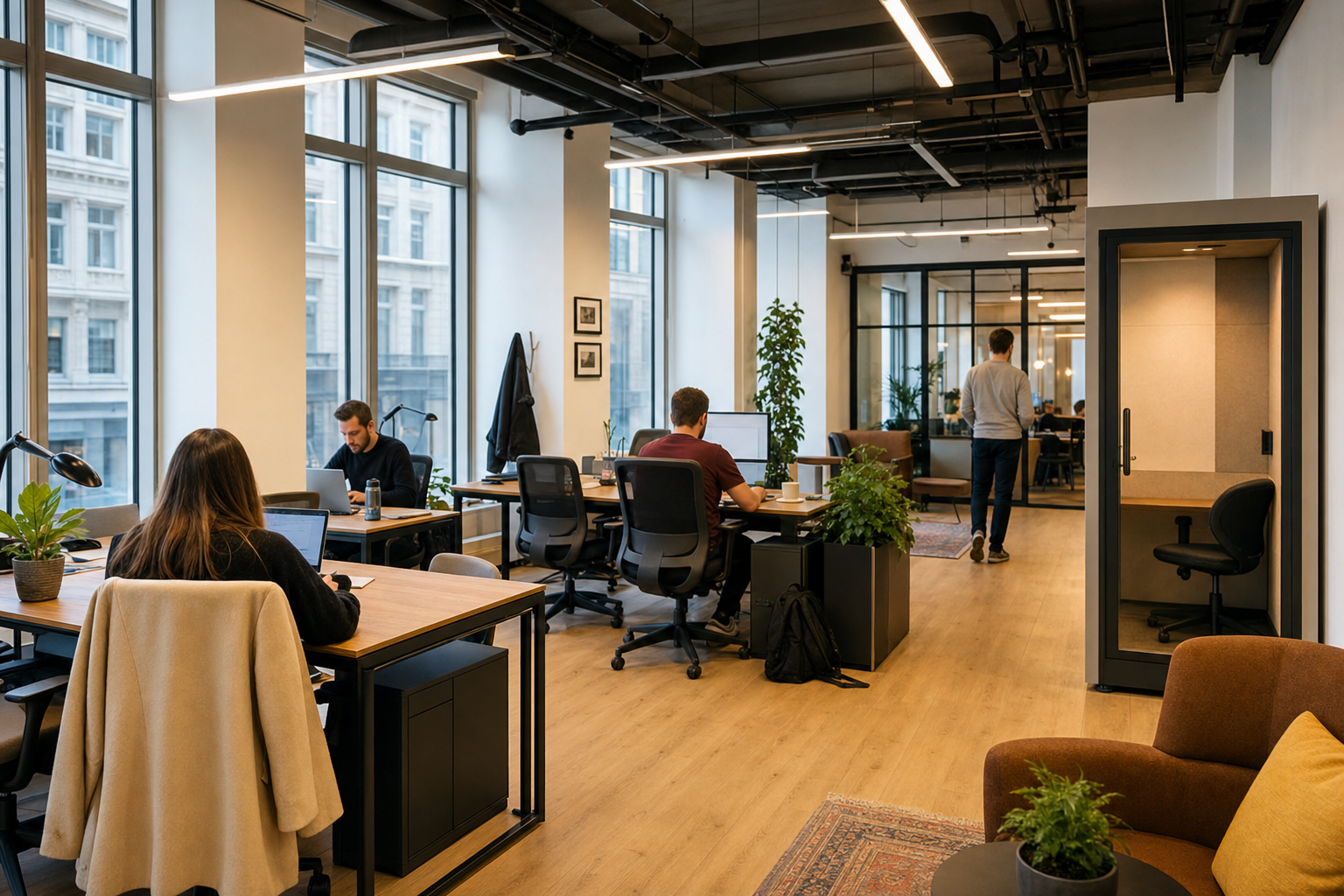
What is Hot desking?
What is Hot Desking? Unpacking the Modern Workspace Revolution
Hot desking is a workspace organization system where desks are shared by different people at different times — no assigned seats, no wasted square footage. Every desk earns its place. The model traces back to naval “hot racking,” where sailors shared bunks on rotating shifts, and it translated directly into corporate real estate strategy: stop paying for empty chairs.
Key Takeaways
- Hot desking is a workspace system where desks are shared by different people at different times, meaning no assigned seats.
- This model ensures that every desk is utilized, preventing wasted office space.
- The concept comes from naval “hot racking,” applying to corporate strategy to stop paying for empty chairs.
Hot Desking vs. Traditional Seating
Traditional offices treat a desk like a personal asset. The chair sits empty on Wednesdays, empty during travel, empty when the employee works from home — but the lease keeps running. Hot desking treats space as a service. For founders watching unit economics, that shift matters. You’re not cutting amenities; you’re aligning cost with actual usage.
Explore reliable hot desking options at Regus London 63 St Mary Axe to see how premium workspaces adapt to this modern approach.
The Strategic Advantages: Why Hot Desking Is Essential Hybrid Infrastructure

Think of hot desking as yield management for real estate. Airlines don’t let seats fly empty; smart operators don’t let desks sit idle. By reducing the physical footprint required per employee, organizations free up capital that would otherwise be locked into square footage. Teams can scale up for a busy quarter and pull back without penalty — no long-term lease holding you hostage to headcount projections you made eighteen months ago.
There’s a second-order benefit that often gets missed: cross-team collision. When people aren’t anchored to the same corner of the office every day, they end up sitting next to colleagues they’d otherwise never meet. I’ve seen this dynamic play out inside fast-scaling teams — the informal conversations that happen at a shared desk often move faster than a scheduled Zoom.
Strategic Flexibility Analysis
Pros
- Reduced Real Estate Costs
- Increased Cross-Team Collaboration
- Scalability on Demand
Cons
- Lack of Personal Storage
- Requires Change Management
- Potential for Disorganization
Overcoming Hot Desking Challenges: What You Need to Get Right
The honest criticism of hot desking isn’t wrong — it’s just incomplete. Yes, without structure, you get hygiene issues, desk hoarding, and a workforce that feels unmoored. These aren’t reasons to abandon the model. They’re a change management checklist.
The teams that struggle with hot desking skip the infrastructure. They announce the policy, remove the nameplates, and expect culture to figure itself out. It won’t. You need booking software that shows real-time availability, physical storage solutions so people aren’t lugging laptops and notebooks daily, and clear sanitization protocols. Get those three right, and most of the friction disappears.
| Challenge | Strategic Solution |
|---|---|
| Lack of Personal Space | Implement digital lockers for daily storage needs. |
| Hygiene Concerns | Enforce strict sanitization protocols and supply stations. |
| Desk Availability Anxiety | Use real-time booking apps to guarantee access. |
The Hotdesk Difference: Instant Booking, Global Access, No Membership Fees
When I was traveling for audits across Cairo, Abu Dhabi, and Doha, finding a professional workspace on short notice was a genuine problem. Either you knew someone with an office, or you ended up in a hotel lobby. That friction — multiplied across thousands of remote workers and distributed teams — is exactly what Hotdesk was built to remove.
Today, the platform gives freelancers and enterprise teams instant, membership-free access to 2,500+ workspaces across the UAE, Egypt, Spain, India, and beyond. Need a private office in Barcelona? Our YADO acquisition put that inventory on the same platform as a hot desk in Dubai. Book by the hour, the day, or the month — whatever the project demands. Plug-and-play productivity, without the overhead of a permanent lease.
Global Footprint
From Dubai to Barcelona, Hotdesk consolidates inventory so hybrid professionals book once and work anywhere — no membership, no long-term commitment.
Discover coworking opportunities at Kube Coworking Lisboa for flexible access across Europe.
Implementing Hot Desking: A Founder’s Playbook for Getting It Right
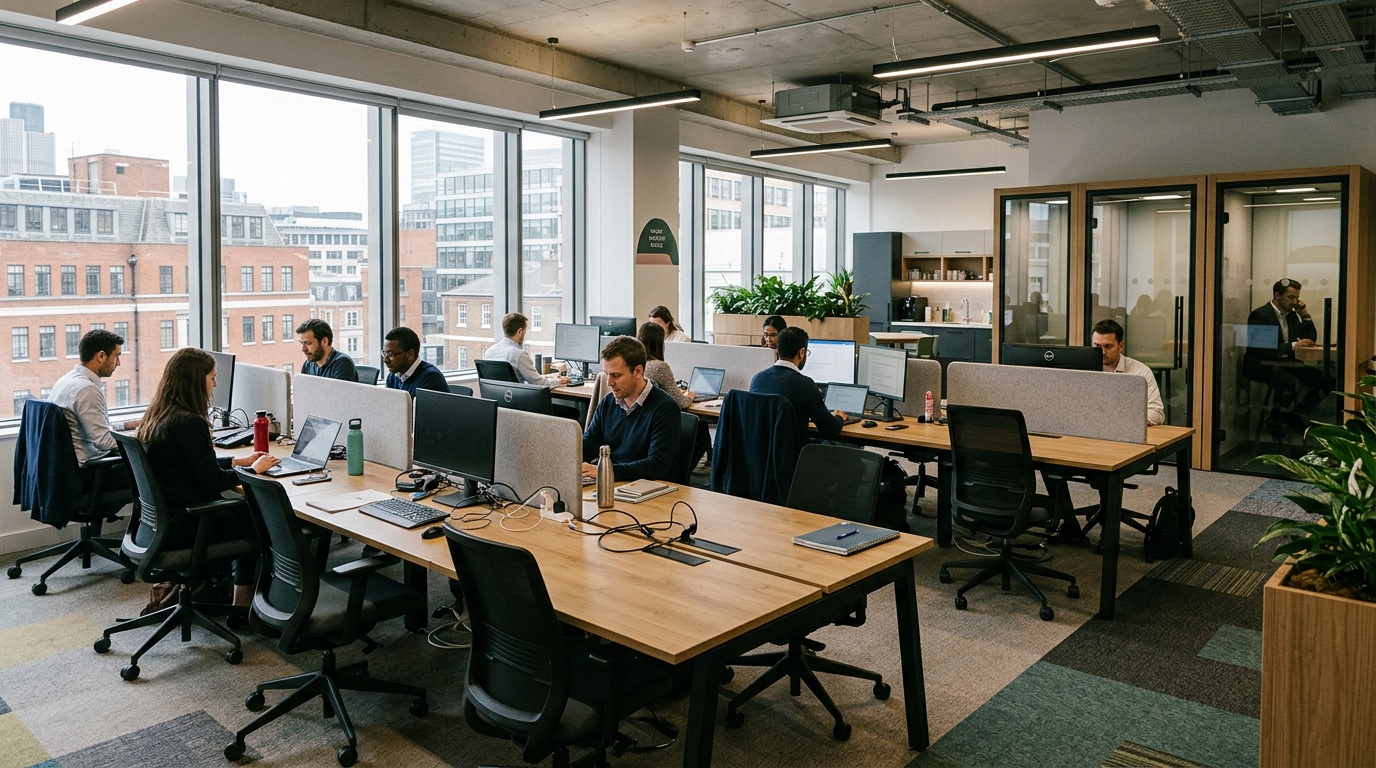
Start with data, not assumptions. Audit your current occupancy — most offices run at 60-70% capacity on a good day. That number tells you how aggressive you can be with your desk-to-employee ratio. A 70% occupancy rate typically supports a 0.7:1 ratio, but you want buffer. Start at 0.8:1, measure for a quarter, then adjust.
Three non-negotiables for rollout: booking software that integrates with your access controls, a written policy on storage and cleanliness, and a feedback loop. Utilization rates tell you if the model is working operationally; employee feedback tells you if it’s working culturally. You need both signals.
If you operate a workspace, this is also where the revenue opportunity sits. Unused desks are overhead. List them on Host.hotdesk.com and turn that idle square footage into a consistent revenue stream — the same way a hotel monetizes every room rather than leaving them dark.
Operator’s Edge
Monetize unused space with Host.hotdesk.com to turn overhead into revenue streams.
Hot Desking Is Infrastructure, Not a Trend
Work is becoming an activity, not a location. That shift isn’t coming — it’s already here, and the organizations still designing around permanent desks are building for a workforce model that no longer reflects how people actually operate. Hot desking isn’t a cost-cutting measure dressed up as innovation. It’s the structural response to a genuinely different relationship between people and place.
From where I sit — having built Hotdesk from evening sessions alongside a full-time role to a platform operating across multiple continents — the teams winning in this environment are the ones who stopped treating flexibility as a perk and started treating it as infrastructure. That’s the mindset shift. Everything else follows.
Boost your hybrid strategy with workspace flexibility at Astrolabs in Dubai.
Frequently Asked Questions
What is the purpose of hot desking?
Hot desking’s core purpose is to optimize real estate efficiency and reduce overhead for organizations. It transforms space from an underutilized asset into a service, aligning capital expenditure with actual workforce usage. This strategic approach allows businesses to scale teams with agility, supporting a dynamic, hybrid work future.
What are the disadvantages of hot desking?
While hot desking offers significant advantages, challenges include a lack of personal storage and the potential for disorganization if not managed well. There can also be hygiene concerns and anxiety around desk availability. Overcoming these requires clear policies, reliable booking software, and amenities that foster community.
What is an example of hot desking?
An example of hot desking is when employees arrive at an office and choose any available desk for the day, rather than having a permanently assigned seat. Our platform, Hotdesk, provides a real-world application, allowing users to book desks on demand in locations from Dubai to Barcelona. This ensures space is always utilized efficiently, adapting to a mobile workforce.
Is hot desking still a thing?
Absolutely, hot desking is not just “still a thing,” it is the operating system for the future of work. As businesses embrace hybrid models and a nomadic workforce, this approach provides the essential infrastructure for productivity. It allows enterprises to book, scale, and thrive without silos, making work an activity rather than a fixed location.
How does hot desking benefit organizations financially?
From a financial perspective, hot desking serves as a yield optimization tool for organizations. It significantly reduces real estate costs by decreasing the physical footprint required per employee, aligning capital expenditure with actual workforce usage. This model also allows operators to monetize unused space, transforming overhead into revenue streams.
What technology is important for successful hot desking?
Successful hot desking relies heavily on technology to ensure seamless execution. Reliable booking software is essential for employees to find and reserve desks efficiently, preventing chaos and desk availability anxiety. Additionally, digital lockers can address personal storage needs, and integration with existing access controls streamlines operations.
How does hot desking support hybrid work?
Hot desking is foundational for the hybrid work future, providing dynamic, infrastructure-level flexibility. It offers employees the autonomy to choose environments that suit their daily tasks, whether for focused work or collaboration. This model supports a global, borderless professional ecosystem, making work an activity rather than a fixed location.
2026 Update: What to Recheck Before Acting on hot desking
This refresh adds a current decision framework for readers comparing options around hot desking. Recheck the offer, implementation requirements, pricing model, support expectations, and proof points before choosing a provider or product.
For the best result, compare practical fit instead of relying on feature lists alone: how quickly the solution can be implemented, what data or integrations it needs, where it creates measurable value, and whether it fits the workflow your team will actually use.
Leave a Reply